
1. Introductions
When planning any electrical installation—whether it’s for a home project or a large-scale commercial job—choosing the right electrical conduit size is one of the most important steps.
Choosing the right electrical conduit size is a bit like picking the right suitcase for a trip. If it’s too small, you can’t fit everything in—and if it’s too big, you’re just carrying extra weight for no good reason. The same idea applies to electrical conduit sizing.
Conduits aren’t just protective tubes—they’re the highways for your wires.
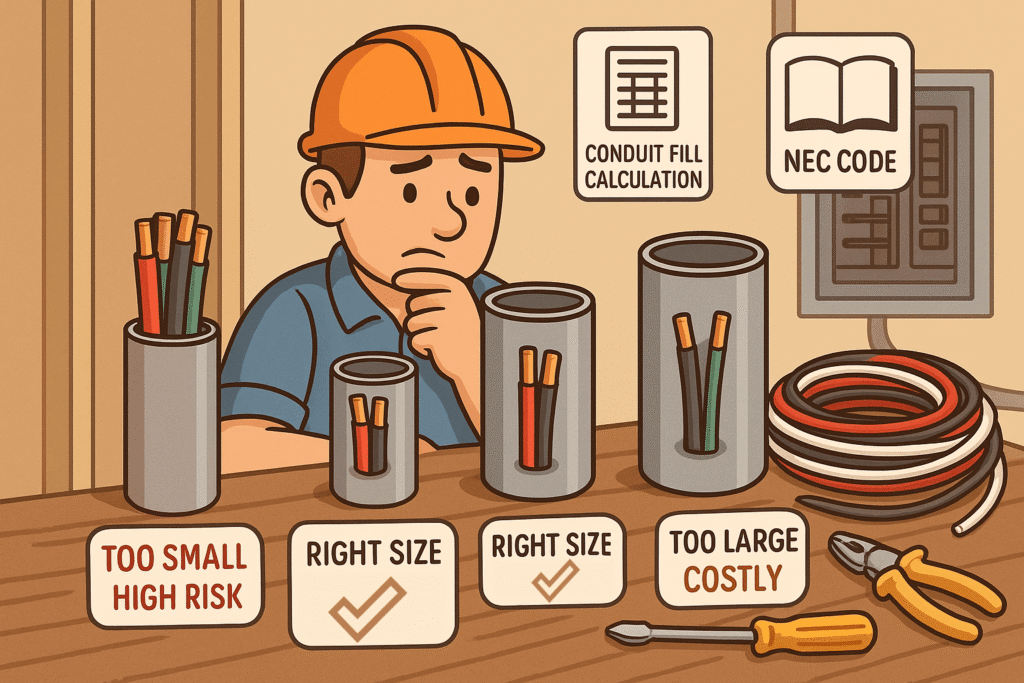
If a conduit is too tight, it can cause the wires to overheat, make it nearly impossible to pull new cables through, or even violate NEC rules (National Electrical Code Conduit Size) .
If it’s too large, you may be spending more money on material and labor than necessary.
If you are wondering what size conduit for 6/3 wire or 8 gauge wire. Or maybe you’re confusing about what size conduit for 200 amp service.
This guide maybe give you the answer, we’ll show you how to calculate, choose, and troubleshoot conduit sizing with examples, fill charts, NEC references, and real-world scenarios. Whether you’re a contractor, engineer, electrician, or someone tackling a DIY electrical project, this post may be helpful.
2. Interactive NEC Conduit Fill Calculator (Quick Tool)
Sizing your conduit shouldn’t require flipping through dozens of NEC Chapter 9 pages. Whether you are planning a new electrical installation or retrofitting an existing system, getting the right conduit size is critical to prevent wire overheating, ensure ease of installation, and comply with safety codes.
Use our Ctube NEC-Compliant Sizing Tool below to instantly determine the appropriate trade size for your PVC conduit based on your specific wire type and quantity.
Conduit Fill Calculator (NEC Compliant)
Note: This tool is designed for quick reference. For complex cable assemblies or critical large-scale infrastructure projects, please verify with your local electrical codes or consult our technical engineering team.
2.1 Quick Reference: PVC Conduit Fill Chart (Based on NEC Chapter 9)
For contractors needing immediate reference without manual calculation, use our pre-calculated fill charts below for THHN/THWN conductors in standard PVC Schedule 40 & 80 conduits.
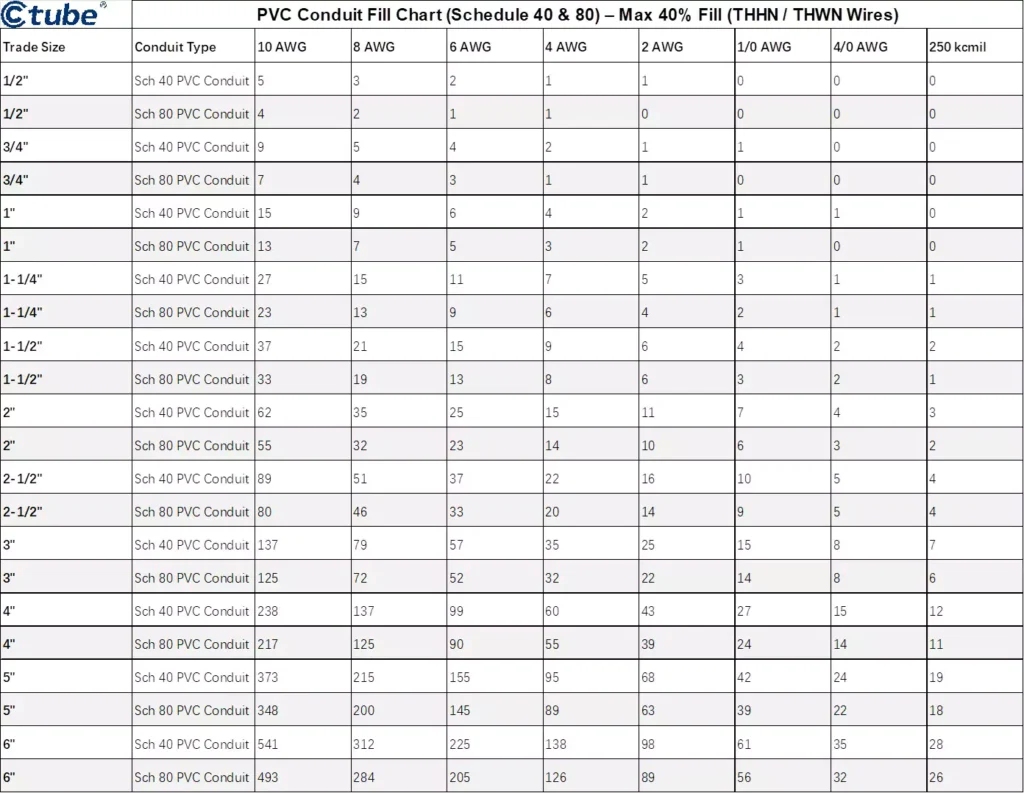
PVC Conduit Fill Chart (Schedule 40 & 80) – Max 40% Fill (THHN / THWN Wires)
| Handelsgröße | Leitungstyp | 10 AWG | 8 AWG | 6 AWG | 4 AWG | 2 AWG | 1/0 AWG | 4/0 AWG | 250 kcmil |
|---|---|---|---|---|---|---|---|---|---|
| 1/2″ | PVC Sch 40 | 5 | 3 | 2 | 1 | 1 | 0 | 0 | 0 |
| 1/2″ | PVC Sch 80 | 4 | 2 | 1 | 1 | 0 | 0 | 0 | 0 |
| 3/4″ | PVC Sch 40 | 9 | 5 | 4 | 2 | 1 | 1 | 0 | 0 |
| 3/4″ | PVC Sch 80 | 7 | 4 | 3 | 1 | 1 | 0 | 0 | 0 |
| 1″ | PVC Sch 40 | 15 | 9 | 6 | 4 | 2 | 1 | 1 | 0 |
| 1″ | PVC Sch 80 | 13 | 7 | 5 | 3 | 2 | 1 | 0 | 0 |
| 1-1/4″ | PVC Sch 40 | 27 | 15 | 11 | 7 | 5 | 3 | 1 | 1 |
| 1-1/4″ | PVC Sch 80 | 23 | 13 | 9 | 6 | 4 | 2 | 1 | 1 |
| 1-1/2″ | PVC Sch 40 | 37 | 21 | 15 | 9 | 6 | 4 | 2 | 2 |
| 1-1/2″ | PVC Sch 80 | 33 | 19 | 13 | 8 | 6 | 3 | 2 | 1 |
| 2″ | PVC Sch 40 | 62 | 35 | 25 | 15 | 11 | 7 | 4 | 3 |
| 2″ | PVC Sch 80 | 55 | 32 | 23 | 14 | 10 | 6 | 3 | 2 |
| 2-1/2″ | PVC Sch 40 | 89 | 51 | 37 | 22 | 16 | 10 | 5 | 4 |
| 2-1/2″ | PVC Sch 80 | 80 | 46 | 33 | 20 | 14 | 9 | 5 | 4 |
| 3″ | PVC Sch 40 | 137 | 79 | 57 | 35 | 25 | 15 | 8 | 7 |
| 3″ | PVC Sch 80 | 125 | 72 | 52 | 32 | 22 | 14 | 8 | 6 |
| 4″ | PVC Sch 40 | 238 | 137 | 99 | 60 | 43 | 27 | 15 | 12 |
| 4″ | PVC Sch 80 | 217 | 125 | 90 | 55 | 39 | 24 | 14 | 11 |
| 5″ | PVC Sch 40 | 373 | 215 | 155 | 95 | 68 | 42 | 24 | 19 |
| 5″ | PVC Sch 80 | 348 | 200 | 145 | 89 | 63 | 39 | 22 | 18 |
| 6″ | PVC Sch 40 | 541 | 312 | 225 | 138 | 98 | 61 | 35 | 28 |
| 6″ | PVC Sch 80 | 493 | 284 | 205 | 126 | 89 | 56 | 32 | 26 |
2.2.Need to source this PVC conduit?
Now that you have your dimensions, ensure your project meets the highest standards of durability and compliance. As a factory-direct manufacturer, we provide the full range of UL-listed PVC conduits, including Schedule 40, Schedule 80, and DB series, ready for bulk shipping. Get Factory Bulk Pricing Today!
3. Understanding Conduit Sizes and Standards
Before we dive into conduit size charts and wire calculations, let’s take a step back to understand conduit sizes.
If you’ve ever bought a pair of shoes from another country, you’ve probably noticed the sizes don’t always match what you’re used to.
A US size 9 isn’t the same as a European size 43, even though they’re for the same foot. The same thing happens with electrical conduit sizes.
3.1 What Is a Conduit Trade Size?
Conduit sizes are usually given in something called a “trade size.” This is like the label size, not the exact measurement.
For example, a 1-inch conduit (trade size) doesn’t have an inner or outer diameter that measures exactly 1 inch. That’s because trade sizes are more of a standard naming system used in the industry to simplify things—not precise measurements.
3.2 Actual Diameter vs Trade Size
Think of it this way: if the trade size is the name of a pizza (“large”), the actual diameter is how big the pizza really is (like 12 inches). The name helps you order, but the exact size can still vary.
A 1-inch Schedule 40 PVC conduit of Ctube, for example, has an actual outer diameter of about 1.315 inches (33.4 mm).
A 1-inch metal conduit may have slightly different dimensions.
Different types of conduit (PVC, EMT, RMC, flexible metal, etc.) have different wall thicknesses, so even if they have the same trade size, the inner space (where the wires go) may differ.
3.3 Inches vs Millimeters: Regional Differences
Depending on where you are, conduit sizes might be listed in inches or millimeters:
In the U.S. and Canada, conduit sizes are mostly in inches (e.g., ½”, ¾”, 1″).
In many other parts of the world, especially Asia and Europe, metric sizes are common (e.g., 20mm, 25mm, 50mm).
4. Factors That Influence Electrical Conduit Size Selection
Now that we’ve covered the basics of conduit sizes, it’s time to look at what actually affects your choice.
Choosing the right conduit isn’t just about picking something that “looks big enough.” It depends on what’s going inside the conduit, where it’s being installed, and what it’s made of.
In this section, we’ll walk through the key factors you need to consider to ensure safe, code-compliant, and efficient conduit sizing.
4.1 Number and Type of Conductors
Think of electrical wires inside a conduit like people in an elevator. The more people you try to fit, the more crowded—and potentially unsafe—it becomes.
Similarly, the number and type of conductors (wires) inside a conduit directly impact how much space you need. The more conductors you plan to run, the bigger the conduit must be.
🧵 Solid vs. Stranded Wires: Stranded wires take up more space because of tiny air gaps between strands.
📏 Different wire gauges: Thicker wires need more room.

➡️ Detailed explained:
- Solid wire is a single, solid piece of metal. It’s compact and doesn’t take up much space.
- Stranded wire is made up of many thin strands twisted together. These strands create small air pockets, making the wire slightly thicker overall.
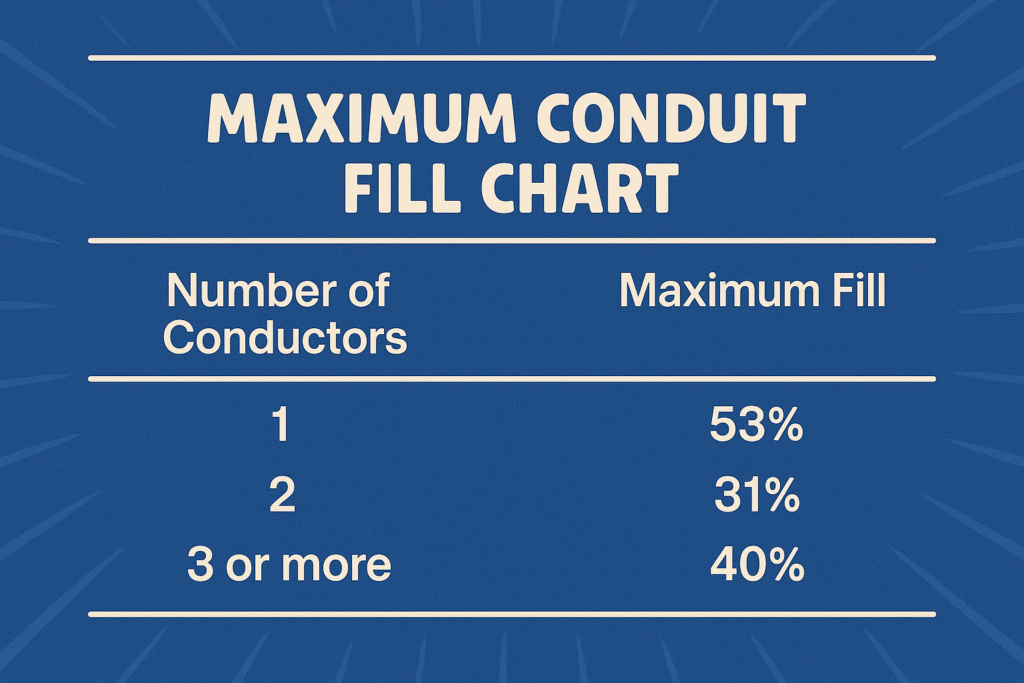
🧮 According to NEC Conduit Fill Table provide the Common Sizes and fill percentages (NEC Chapter 9Table 1)
- 1 wire: max 53% fill
- 2 wires: max 31% fill
- 3 or more wires: max 40% fill
4.2 Conductor Insulation and Voltage Rating
Not all wire insulation is created equal. Some types, like THHN or XHHW, are thinner, while others are thicker for higher voltage or better protection. The thicker the insulation, the more space each wire takes up.
Also, high-voltage wires may need more spacing between conductors, depending on code requirements and safety margins, which affects how large the conduit needs to be.
💡 Imagine each wire wearing a jacket—the thicker the jacket, the more room it takes up. And if that wire carries more voltage, the jacket needs to be thicker for safety.
4.3 Conduit Material and Conduit Types
PVC, metal, RTRC (fiberglass conduit), HDPE, —each type of conduit has different wall thicknesses, which means different interior diameters, even if the trade size is the same.
For example, same sizes PVC Schedule 40 has a larger inner space than Schedule 80 because the walls are thinner.
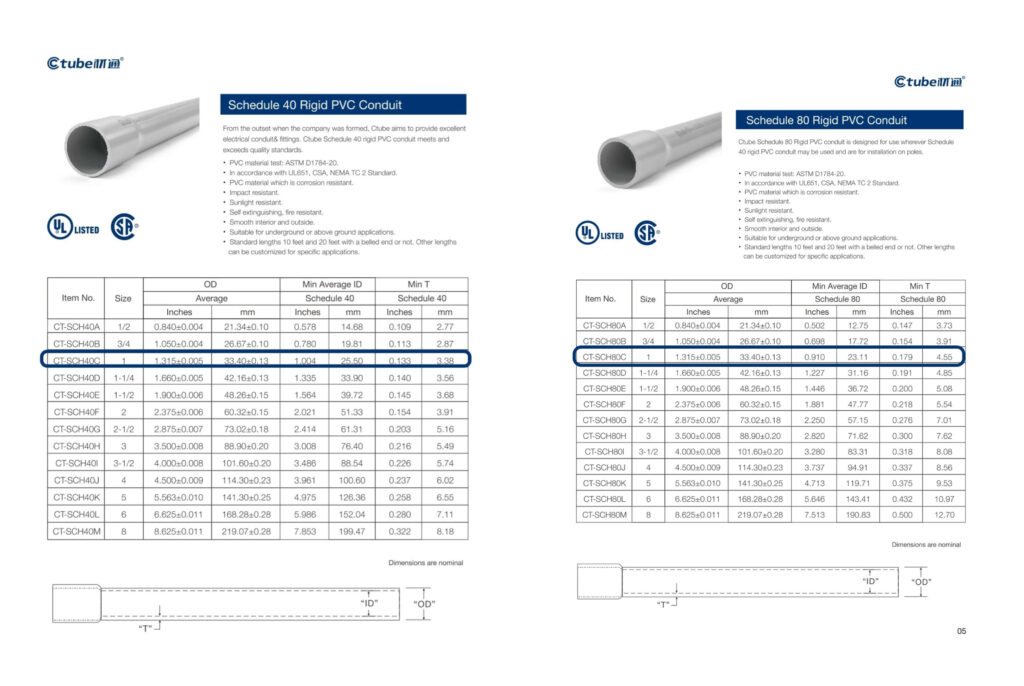
Rigid metal conduits (RMC) have thicker walls than EMT (Electrical Metallic Tubing), so you get less space inside even if the trade size is the same.
Same sizes PVC rigid conduit may be have a smaller inner space than Electrical Metallic Conduit (EMT) for its thinner wall thickness.
💡 It’s important to note that flexible conduit and rigid conduit have different designs. Even they are made from same material and labeled the same size, their actual internal space can be very different.
Rigid conduit is stiff and holds its shape, so the internal space is more consistent and predictable.
Flexible conduit, on the other hand, is bendable and made from a coiled material, which means it has tiny gaps and spaces between the coils.

4.4 Installation Environment: Temperature, Bends, Moisture, and Sunlight Exposure
Temperature: High-heat environments may require larger conduit for better ventilation.
Bends and curves: Wires are harder to pull through tight bends. A slightly larger conduit can make the pull smoother and avoid damage.
Moisture: In wet or underground areas, you may need sealed PVC or corrosion-resistant conduits.
Sunlight: UV exposure can weaken some plastics, so UV-rated materials may be needed.
The tougher the environment, the more likely you’ll need to upsize for safety and ease of maintenance.
5. How to Use Fill Chart and Calculate Electrical Conduit Size
Now that we’ve gone through the basic rules and charts, let’s look at how this all works in real life.
5.1 Guideline for Conduit Size Choosing and Fill Chart Usage
📌 You Can Use Different Methods Depending on the Situation
👉 Option 1: Use a Conduit Fill Chart
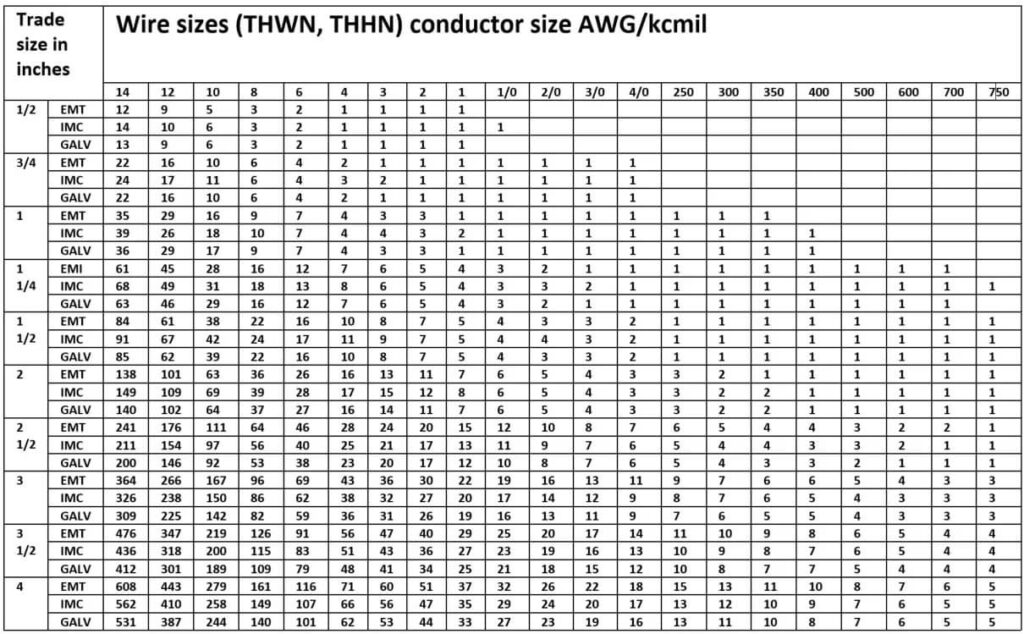
This is the easiest and fastest way. Just look up your wire type and size, and the chart tells you what size conduit will work. It’s perfect for common wire setups and quick jobs.
For on-site quick reference, save our PVC Conduit Fill Chart image below, or use the detailed data table for precise engineering checks.
👉 Option 2: Do the Math Manually
This is a better choice when you have multiple wire sizes, special conditions, or need a very accurate result.
💡 If you decide to calculate it manually – whether you’re trying to figure out how many wires fit in a conduit, or which conduit size you need, we’ve got a simple method for you to calculate conduit fill.
💡 Schritt 1: Figure out what kind of wires you’re using. That includes the wire size (called gauge), insulation type (like THHN), and how many wires you need to run.
💡 Schritt 2: Know what kind of conduit you’re using. EMT, RMC, and PVC conduit all have different inner space, even if they’re the same “size.”
💡 Schritt 3: Look up the wire’s size in NEC Table 5 to find the space (area) it takes up. Then, check NEC Chapter 9, Table 4 or Annex C to see how many of that wire can fit in your conduit type and size.
💡 Schritt 4: Make sure you don’t go over the “fill limit.”(Table above) For most cases, you shouldn’t fill more than 40% of the space inside the conduit when running more than two wires.
📌Depending on your situation—like the number of wires, their type, and the conduit material—the exact steps might vary slightly.
For example, calculating fill for a single wire type is simpler than figuring out a mixed group of wires or planning a multi-voltage system.
Here we make some examples for you to better understand.
5.2 Example 1: How Many #10 THHN Wires in 3/4″ EMT? (single conductor)
🟢 First Method: Using a Conduit Fill Chart
This method is much quicker because it uses a chart that already does the math for you.
- You just need to:
- Look up the conduit size you’re using (e.g., 3/4″ EMT).
- Find the wire size (e.g., #10 THHN) in the chart.
- The chart will tell you exactly how many of those wires can fit in the conduit, based on its size.
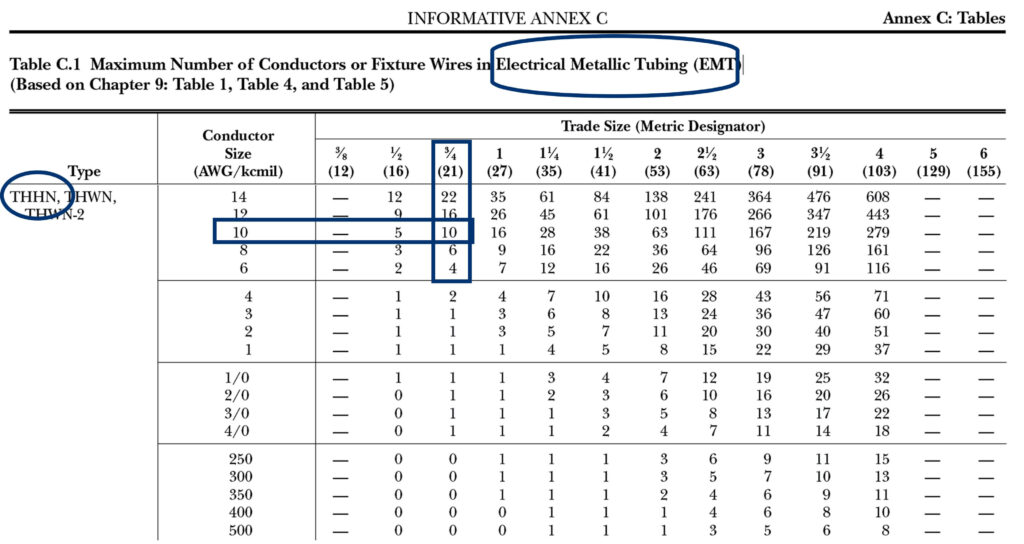
It’s like using a shortcut—just find your size and wire type, and the chart gives you the answer instantly! No need for calculations.
🔴 Second Method: Manual Calculation Using Steps
Step 1: Find the area of one #10 THHN wire
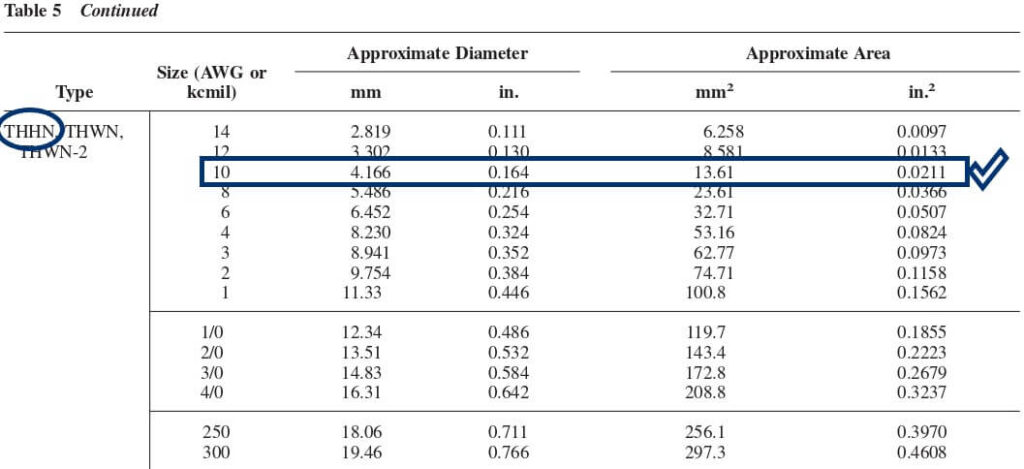
We’ll start by looking at NEC Table 5 to determine the area of a #10 THHN wire.
According to this table, the area for a single #10 THHN wire is 0.0211 square inches.
Schritt 2: Ermitteln Sie die zulässige Füllfläche des ¾"-EMT-Rohrs.
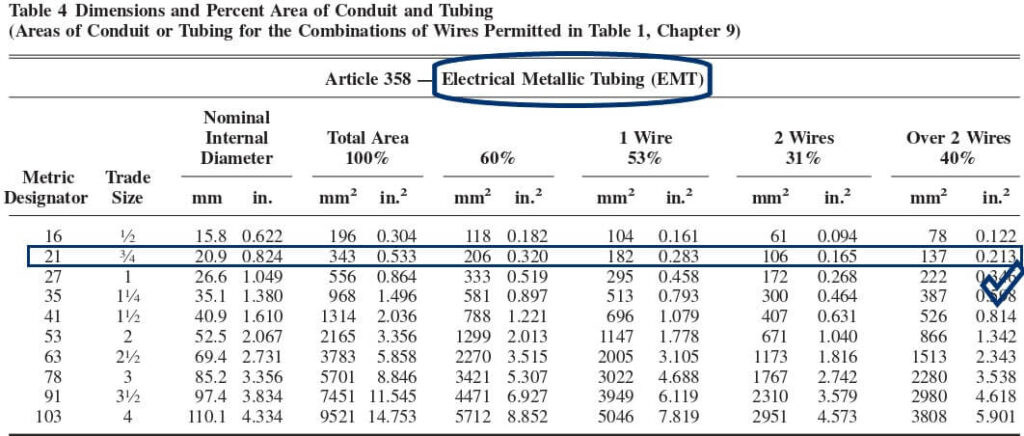
Als Nächstes konsultieren wir die NEC Tabelle 4 oder Anhang C für die Füllkapazität eines 3/4″ EMT-Rohrs.
Bei 3/4″ EMT-Rohren beträgt der verfügbare Platz 0,533 Quadratzoll.
Füllgrenze 40% = 0,533 × 0,40 = 0,2132 in²
Schritt 3: Dividieren Sie, um herauszufinden, wie viele Drähte passen.
0,2132 ÷ 0,0211 ≈ 10,1
✅ Das bedeutet, dass Sie bis zu 10 #10 THHN-Drähte sicher in einem ¾" EMT-Rohr verlegen können, wenn Sie die Füllregel 40% befolgen.
🔍 Möglicherweise sehen Sie die Bezeichnung THHN für den Kabeltyp – das ist die Isolierungsart, die für Installationen in trockenen Umgebungen bei hohen Temperaturen entwickelt wurde und häufig in Schutzrohren verwendet wird.
5.3 Eine komplexere Kabelführung: Einführung und Beispiel
- In dem Beispiel, das wir gerade durchgegangen sind, war die Sache einfach:
- Wir haben nur einen Kabeltyp verwendet: #10 THHN
- Alle Drähte hatten die gleiche Größe und den gleichen Typ.
- Es gab keine scharfen Kurven oder besondere Installationsanforderungen.
Doch im wirklichen Leben können die Dinge komplizierter werden.

📌 Darum kann das Befüllen von Leitungen in der Praxis knifflig werden:
- Es könnten Drähte unterschiedlicher Größe oder mit unterschiedlichen Isolationsarten vorliegen (z. B. eine Mischung aus THHN und XHHW).
- Manche Drähte können unterschiedliche Spannungen führen, was bedeutet, dass sie möglicherweise getrennt werden müssen.
- Bei langen Kabelstrecken kann zusätzlicher Platz erforderlich sein, um die Zugspannung zu reduzieren.
- Wenn das Schutzrohr viele Biegungen oder Windungen aufweist, kann das Durchziehen der Drähte schwieriger sein, sodass möglicherweise ein größeres Schutzrohr benötigt wird.
- Manchmal wird im Leitungsrohr zusätzlicher Platz für zukünftige Erweiterungen oder eine einfachere Wartung benötigt.
💡 Deshalb ist die Berechnung bei komplexeren Projekten nicht immer so einfach.
Möglicherweise müssen Sie Folgendes tun:
- Schauen Sie sich mehr als eine NEC-Tabelle an (z. B. Tabelle 5, Tabelle 8 und Anhang C).
- Addieren Sie den Platzbedarf der einzelnen Drahtarten.
- Oder verwenden Sie einen Online-Füllmengenrechner für Leitungen, um sicherzustellen, dass Sie innerhalb der sicheren Grenzwerte bleiben.
👉 ZusamenfassendJe mehr Drahtarten oder Sonderbedingungen vorliegen, desto sorgfältiger muss die Berechnung sein.
Beispiel 2: Sie verlegen in einem Gewerbegebäude Kabel von einem Verteilerkasten zu einem Unterverteiler über eine Strecke von 60 Fuß.
- 3 Drähte #6 THHN (für einen 240V-Stromkreis)
- 1 #10 THHN-Draht für Erdung
- 2 Steuerleitungen: #12 XHHW
- Die Leitung wird zwei 90-Grad-Bögen aufweisen.
- Sie möchten ein 1-Zoll-PVC-Rohr (Schedule 40) verwenden.
📌 Schritt für Schritt
Schritt 1. Erstellen Sie eine Liste Ihrer Kabel und deren Typen.
- 3x #6 THHN
- 1x #10 THHN
- 2x #12 XHHW
Jedes dieser Geräte hat eine andere Größe und Isolierung, daher benötigen sie unterschiedlich viel Platz.
Schritt 2. Ermitteln Sie die Fläche (den Querschnitt) jedes Drahtes.
Aus NEC Tabelle 5:
- #6 THHN ≈ 0,0507 in²
- #10 THHN ≈ 0,0211 in²
- #12 XHHW ≈ 0,0181 in²

Dann der XHHW
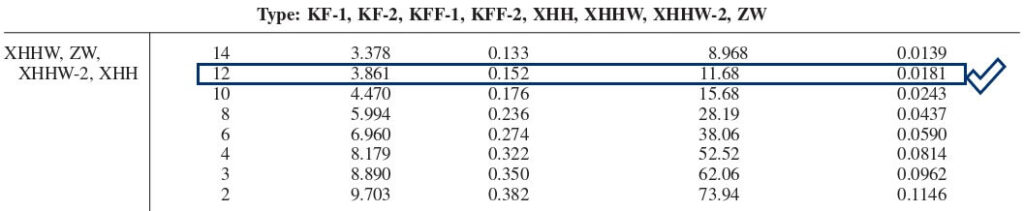
Multipliziere nun jeden Wert mit der jeweiligen Menge:
- 3 x 0,0507 = 0,1521 in²
- 1 x 0,0211 = 0,0211 in²
- 2 x 0,0181 = 0,0362 in²
- Gesamtdrahtquerschnitt = 0,2245 in²
Schritt 3. Ermitteln Sie die zulässige Füllmenge für 1-Zoll-PVC-Rohre.
Nach NEC: 40% Füllmenge für mehr als 2 Drähte in 1-Zoll-PVC-Rohr = 0,333 in²
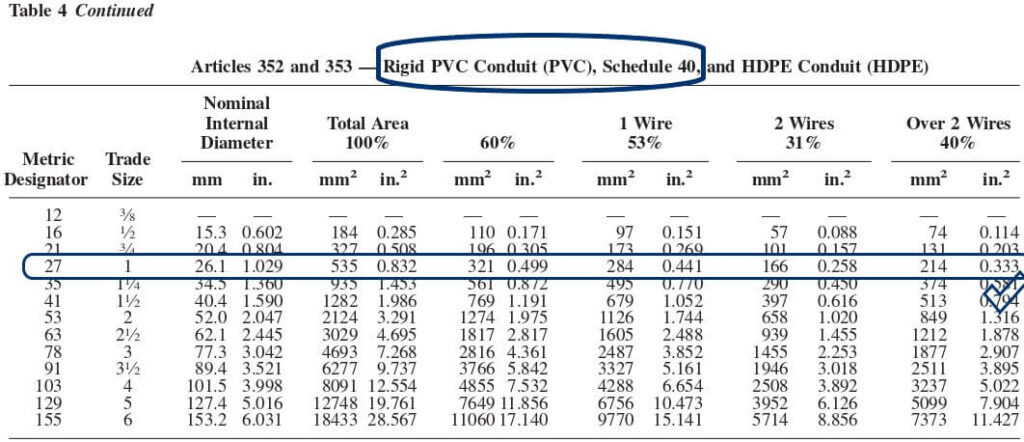
4. Vergleichen Sie die Gesamtdrahtquerschnittsfläche mit der Leitungskapazität.
- Gesamtdrahtquerschnitt = 0,2245 in²
- Füllgrenze für 1″ PVC 40% = 0,333 in²
✅ Sie befinden sich innerhalb der Grenzen – also ist alles sicher!
🔎 Aber es gibt noch mehr zu bedenken:
- Da es zwei 90°-Biegungen gibt, wird das Durchziehen der Drähte schwieriger sein.
- Für eine einfachere Installation empfiehlt sich eventuell die Verwendung eines 1¼-Zoll-Rohrs.
- Oder verwenden Sie weite Kurven anstelle enger.
5.4 Beispiel 3: Welche Größe des Schutzrohrs ist für einen 200-Ampere-Anschluss erforderlich (bei Verwendung von #3/0 THHN)?
✅ 2 Außenleiter + 1 Neutralleiter + 1 Erdungsleiter = 4 Drähte für einen 200-Ampere-Anschluss.
🔴 Schritt 1: Den Drahtfüllbereich finden
Gemäß NEC Kapitel 9, Tabelle 5, benötigt ein #3/0 THHN-Draht 0,2679 in² Platz.
- 2 stromführende Drähte
- 1 Neutralleiter
- 1 Erdungsdraht (Nehmen wir vorerst #4 THHN an, was laut Tabelle 0,0824 in² entspricht.)
Die Gesamtfläche beträgt also:
- 3 × 0,2679 in² = 0,8037 in²
- 1 × 0,0824 in² = 0,0824 in²
- Gesamt = 0,8858 in²
🔴 Schritt 2: Die Regel für die Rohrfüllung anwenden
Da Sie mehr als zwei Leiter verwenden, beträgt die maximale Füllmenge gemäß NEC Tabelle 1 40% des gesamten Leerrohrvolumens.
Nun müssen wir ein Rohr finden, dessen 40%-Füllung mindestens 0,8858 in² beträgt.
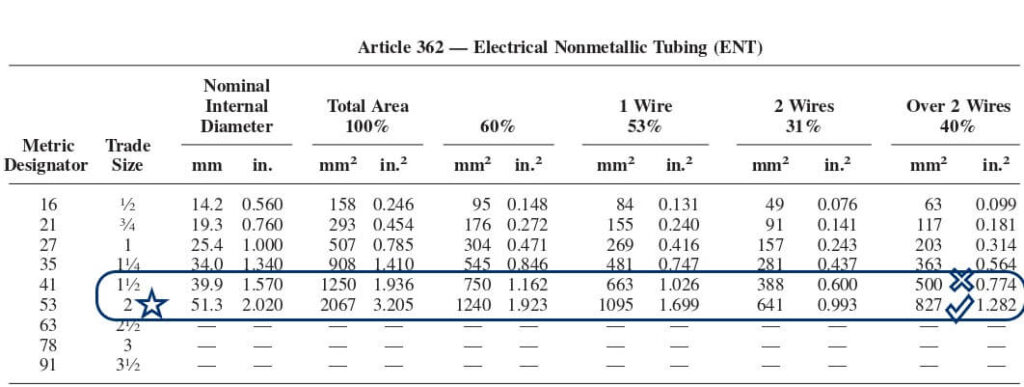
Versuchen wir es mit 1,5 Zoll EMT: Gesamtvolumen: 0,774 in² bei einer Füllmenge von 401 TP3T
Das reicht nicht aus (da 0,794 < 0,8858).
Versuchen wir es mit 2-Zoll-EMT-Rohren: Gesamtvolumen: 1,282 in² bei einer Füllmenge von 401 TP3T
Das genügt (da 1,282 > 0,8858).
✅ Antwort: Sie können verwenden 2 Rettungssanitäter Schutzrohr für diese 200-Ampere-Anlage mit 3/0 THHN-Leitern.
💡 Erklärung für Sie, Falls Sie etwa 200 Ampere und 3/0 THHN verwechseln.
✅ 1. 200 Ampere bestimmen den Kabelquerschnitt
Wir können nicht einfach raten, welchen Draht wir verwenden sollen – wir müssen die Drahtgröße danach auswählen, wie viel Strom (in Ampere) das System führen muss.
Ampere (kurz für Ampere) misst den Fluss von elektrischem Strom.
In diesem Fall benötigt Ihr System eine Stromstärke von 200 Ampere.
Gemäß dem NEC (National Electrical Code) ist eine gängige Drahtgröße für die sichere Übertragung von 200 Ampere #3/0 (genannt “drei-null”). .
#3/0 ist ein dickwandiges Kabel mit ausreichender Kapazität für 200 Ampere.
✅ 2. Die Drahtgröße bestimmt die Rohrgröße
Sobald Sie den Drahttyp und die Größe kennen – wie z. B. #3/0 THHN – können Sie seinen Durchmesser und den Platzbedarf (die Fläche) nachschlagen.
Addieren Sie den Platzbedarf aller Kabel. Anhand der NEC-Vorgaben zur Rohrbelegung (in der Regel maximal 40% für mehr als zwei Kabel) können wir dann die benötigte Rohrgröße ermitteln.
✅ 3. Warum 4 Drähte für einen 200-Ampere-Anschluss?
Manchmal können auch 3 Drähte verwendet werden, aber nur in bestimmten Fällen – in der Regel dann, wenn das Rohr oder Kabel aus Metall besteht und als Erdungsdraht dienen kann.
5.5 Beispiel 3: Welche Größe sollte das Schutzrohr für 6/3-Draht (THHN) haben?
🧐 Was bedeutet “6/3”?
Die Bezeichnung 6/3 steht für einen Kabeltyp mit folgenden Eigenschaften:
- “6” = Drahtstärke (AWG #6)
- “3” = drei stromführende Leiter
- Üblicherweise ist auch ein blanker Erdungsdraht enthalten, sodass sich insgesamt vier Drähte im Kabel befinden.
- 👉 Sie haben es also mit insgesamt 4 Drähten zu tun.
Diese Konfiguration ist üblich für Geräte wie elektrische Wäschetrockner, Backöfen oder Unterverteilungen in Wohngebäuden.
📐 Schritt für Schritt: So wählen Sie die richtige Rohrgröße
✅ Schritt 1: Den Drahtbereich ermitteln
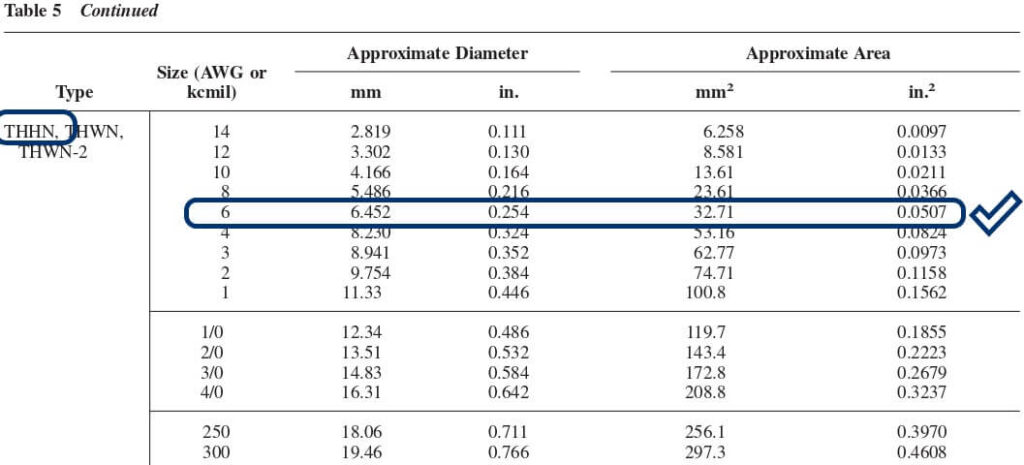
Gemäß NEC Tabelle 5 gilt: #6 THHN = 0,0507 in² pro Draht
Gesamt für 4 Drähte: 0,0507 × 4 = 0,2028 in²
✅ Schritt 2: NEC-Füllregel anwenden
Bei mehr als zwei Drähten in einem Schutzrohr beträgt die Füllgrenze nach NEC 40%.
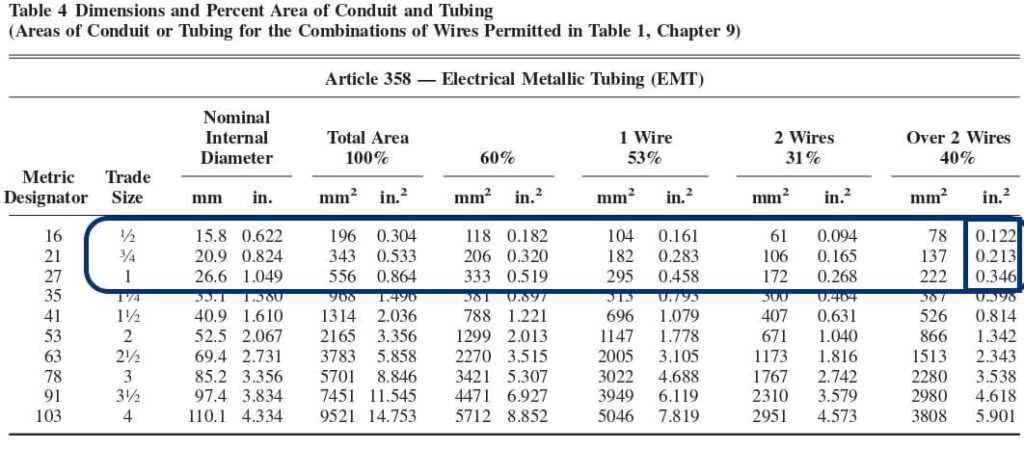
✅ Schritt 3: Die richtige Größe finden. Hier prüfen wir die Fülltabelle für EMT-Rohre.
| EMT-Größe | 40% Füllmenge (max.) | Reicht das für 6/3 THHN? |
| ½” EMT | 0,122 in² | ❌ Nein (zu klein) |
| ¾” EMT | 0,213 in² | ✅ Ja (passt für 0,2028 in²) |
| 1″ EMT | 0,346 in² | ✅ Ja, mit zusätzlichem Platz |
6. Crucial Difference: PVC Schedule 40 vs. Schedule 80 Sizing in Real-World MEP Projects
Many electrical contractors make a costly assumption: assuming a 2-inch PVC conduit has the same internal volume regardless of its schedule rating. This is a critical NEC compliance trap.
Because PVC Schedule 80 is engineered with a thicker wall to withstand higher physical impact and crush resistance (in strict accordance with UL 651 Und NEMA TC 2), its Internal Diameter (ID) is significantly smaller than Anlage 40.
If you max out the 40% fill capacity based on Schedule 40 calculations, and the site engineer switches to Schedule 80 for high-traffic underground burial, your wires will not fit, leading to massive increases in pulling tension, jacket chafing, and double labor costs.
Here is the exact numerical breakdown for 2″ Trade Size PVC:
| Leitungstyp | Outer Diameter (OD) | Wall Thickness (Min) | Internal Area (100%) | Max Allowable Fill Area (40% NEC Limit) |
|---|---|---|---|---|
| 2″ PVC Schedule 40 | 2.375 in (60.32 mm) | 0.154 in (3.91 mm) | 3.356 in² | 1.342 in² |
| 2″ PVC Schedule 80 | 2.375 in (60.32 mm) | 0.218 in (5.54 mm) | 2.953 in² | 1.181 in² |
Data referenced from NEC Chapter 9, Table 4. Note the ~12% reduction in usable fill area when upgrading to Sch 80.
6.1 How to Calculate Conduit Fill for Mixed Wire Batches (PVC Sch 40 Example)
Let’s calculate a common commercial run: You are routing a feeder circuit using 2″ PVC Schedule 40. The required conductors are:
- 3x #3/0 AWG THHN (Phase conductors)
- 1x #1 AWG THHN (Neutral)
- 1x #4 AWG THHN (Equipment Grounding Conductor)
Step 1: Cross-Sectional Area Calculation (NEC Table 5)
- #3/0 THHN: 0.2679 in² × 3 = 0.8037 in²
- #1 THHN: 0.1564 in² × 1 = 0.1564 in²
- #4 THHN: 0.0824 in² × 1 = 0.0824 in²
- Total Conductor Area = 1.0425 in²
Step 2: Verification Against PVC Conduit Capacity Comparing the total conductor area (1.0425 in²) to the 2″ PVC Sch 40 max fill limit (1.342 in²), the fill ratio is approximately 31%. This is well below the NEC 40% maximum allowable fill limit.
Contractor Insight: A 31% fill ratio ensures smooth wire pulling, minimizes heat buildup in heavy-load circuits, and drastically reduces the risk of insulation damage during installation.
7. Schlussfolgerung
Die Wahl des richtigen Rohrdurchmessers ist nur der erste Schritt für ein erfolgreiches Elektroprojekt. Die langfristige Zuverlässigkeit Ihrer Infrastruktur – ob unterirdisch oder oberirdisch – hängt maßgeblich von der Materialqualität und der Einhaltung der gesetzlichen Bestimmungen der installierten Rohrleitungssysteme ab.
Bei C-Tube, Wir liefern nicht nur Rohre, wir entwickeln und fertigen sie auch. Als spezialisierter Hersteller von UL-gelisteten PVC-Rohrsystemen schließen wir die Lücke zwischen Serienfertigung und Präzisionstechnik. Von starren Rohren der Normen Schedule 40/80 bis hin zu unseren speziellen Versorgungsleitungen der Typen DB 60/100/120 – wir stellen sicher, dass jedes Rohr, das unser Werk verlässt, den hohen Anforderungen moderner Elektroinstallationen gerecht wird.
Warum sollten Sie Ctube für Ihr nächstes Projekt wählen?
-
Vorteile durch Direktvertrieb ab Werk: Zwischenhändlerkosten eliminieren und gleichzeitig die Produktqualität streng kontrollieren.
-
Vollständige Einhaltung: Alle unsere Produkte werden gemäß den Normen ASTM D1784, UL651 und NEMA TC 2 hergestellt.
-
Entwickelt für Langlebigkeit: Korrosionsbeständige, stoßfeste und selbstverlöschende Eigenschaften gewährleisten, dass Ihre Installation jahrzehntelang hält.
Kontaktieren Sie den Vertrieb/Fordern Sie ein Angebot an!
8. More Information for You
💡 In diesem Beitrag stellen wir die Definition von Leitern und Drahtstärken (AWG) sehr detailliert und leicht verständlich vor. Sie können ihn nach Belieben lesen: Füllstandstabellen für PVC-Rohre verstehen: Ein umfassender Leitfaden (2025), Hier erfahren Sie mehr und können die in diesem Beitrag erwähnten relevanten Begriffe besser verstehen.
📝Und falls Sie mehr über das Messen von Leitungsgrößen erfahren möchten, können Sie sich diesen Beitrag ansehen. Wie man die Länge und den Durchmesser von Elektroinstallationsrohren misst.
🔵 Wir bei Ctube sind spezialisiert auf die Herstellung hochwertiger PVC-Rohre und -Fittings, die für sichere und effiziente Elektroinstallationen konzipiert sind.
Unsere Produkte erfüllen internationale Standards wie UL, CSA und AS/NZS 2053, und wir bieten eine breite Palette an Leitungsarten und -größen an – einschließlich starre Leitungen wie Anlage 40, Anlage 80, DB, EB, elektrische nichtmetallische Leitungen und spezielle Serien wie Solar-UPVC Und raucharm, halogenfrei Optionen.
Ob Sie an einem Wohn-, Gewerbe- oder Industrieprojekt arbeiten, Ctube unterstützt Sie mit zuverlässigen, zertifizierten Lösungen und fachkundiger Beratung.
9. Häufig gestellte Fragen
Gilt die Füllregel 40% auch, wenn ich nur ein einzelnes Kabel verlege?
Nein, gemäß NEC Kapitel 9 darf ein einzelner Leiter bis zu 53% der Querschnittsfläche des Schutzrohrs ausfüllen.
Wie hoch ist der Füllgrad bei zwei Drähten in einem PVC-Rohr?
Bei genau zwei Leitern begrenzt der NEC die Füllkapazität strikt auf 31%, um ein Verklemmen beim Einziehen zu verhindern.
Muss ich den Erdungsdraht in meine Berechnung der Rohrfüllung einbeziehen?
Ja, alle physischen Leiter, einschließlich blanker oder isolierter Schutzleiter, müssen in die Gesamtfüllfläche einbezogen werden.
Ist die Füllkapazität für PVC nach Schedule 80 die gleiche wie für PVC nach Schedule 40?
Nein, Schedule 80 hat eine dickere Wandstärke, wodurch sich der Innendurchmesser (ID) verringert und somit eine geringere Drahtfüllkapazität als bei Schedule 40 erreicht wird.
Gilt die NEC-Regel zur Rohrfüllung auch für Niederspannungs-Datenkabel (Cat6)?
Während der NEC keine gesetzlichen Füllgrenzen für Niederspannungs-PoE/Datenkabel vorschreibt, empfehlen die TIA/EIA-Standards dringend eine maximale Füllmenge von 40%, um Signalbeeinträchtigungen und Kabelquetschungen zu vermeiden.
Wie berechne ich die Rohrfüllung für nicht-runde Kabel wie Romex (NM-B)?
Flache/elliptische Kabel müssen wie ein massiver kreisförmiger Leiter behandelt werden, wobei die größte Abmessung (der größte Durchmesser) zur Berechnung der Querschnittsfläche herangezogen wird.
Kann ich in demselben Schutzrohr Drähte unterschiedlicher Größe (z. B. 10 AWG und 4 AWG) mischen?
Ja, aber Sie können keine Standardtabelle verwenden; Sie müssen die Summe der Querschnittsflächen jedes einzelnen Drahtes manuell berechnen und sicherstellen, dass sie unter dem Grenzwert 40% bleibt.
Was verursacht Kabelverklemmungen in PVC-Rohren?
Ein Blockieren tritt typischerweise dann auf, wenn die Summe der Außendurchmesser dreier Leiter das 2,8- bis 3,2-fache des Innendurchmessers des Rohres beträgt.
Does conduit bending affect the allowable fill percentage?
Die 40%-Regel bleibt unverändert, jedoch erhöhen mehrere 90-Grad-Biegungen die Zugspannung erheblich, sodass Sie möglicherweise den Durchmesser des Schutzrohrs vergrößern müssen, um Kabelschäden zu vermeiden.
Do I calculate fill capacity using the nominal size or actual internal diameter?
Calculations must always be based on the precise actual internal diameter (I.D.) listed in NEC Chapter 9, Table 4, not the trade/nominal size.
What happens if I exceed the 40% maximum fill limit?
Exceeding the limit causes severe heat buildup (preventing heat dissipation), damages wire insulation, and will result in a failed inspection.
Are the fill charts the same for ENT (Smurf Tube) and Rigid PVC?
No, Electrical Nonmetallic Tubing (ENT) has different interior dimensions compared to Rigid PVC (Sch 40/80) and requires its own specific fill calculations.
Does ambient temperature affect the conduit fill limit?
Ambient temperature does not change the physical 40% fill limit, but it does require you to derate the ampacity of the conductors inside.
Is pulling lubricant required if I stay under the 40% fill limit?
The NEC doesn't explicitly mandate lubricant, but it is highly recommended by contractors for any PVC run nearing 35 fill to reduce sidewall friction.
Why does my calculated fill differ slightly from online calculators?
Calculators often use generic NEC Table 5 dimensions, but exact outer diameters (O.D.) can vary slightly depending on the specific insulation manufacturer.



 English
  French
  Spanish
  German
  Arabic
  Indonesian
  Vietnamese