
1. Introductions
When planning any electrical installation—whether it’s for a home project or a large-scale commercial job—choosing the right electrical conduit size is one of the most important steps.
Choosing the right electrical conduit size is a bit like picking the right suitcase for a trip. If it’s too small, you can’t fit everything in—and if it’s too big, you’re just carrying extra weight for no good reason. The same idea applies to electrical conduit sizing.
Conduits aren’t just protective tubes—they’re the highways for your wires.
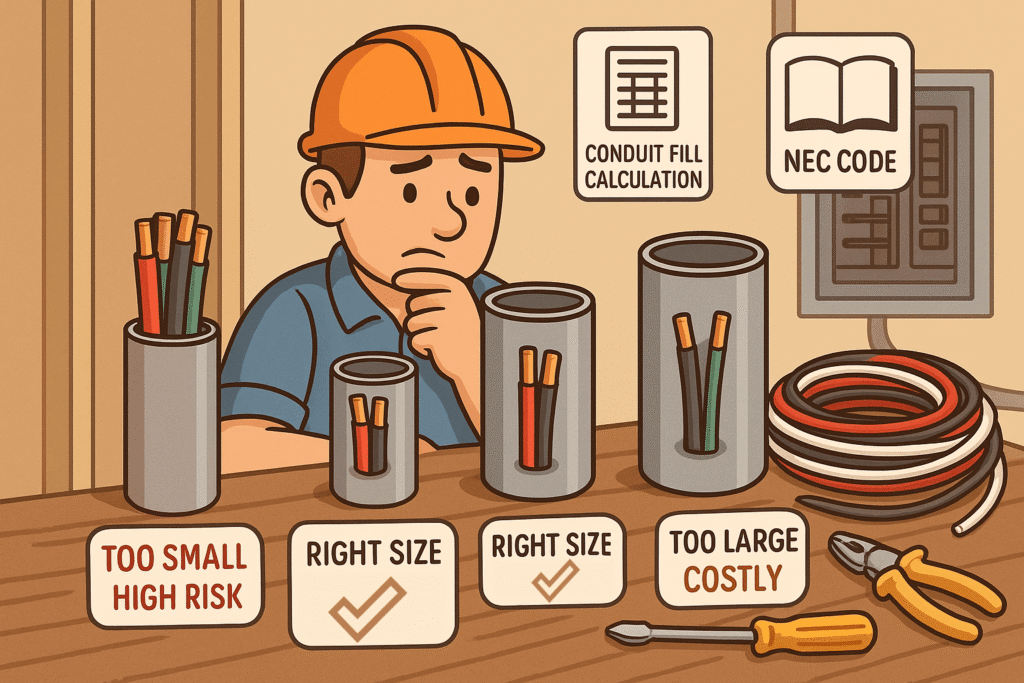
If a conduit is too tight, it can cause the wires to overheat, make it nearly impossible to pull new cables through, or even violate NEC rules (National Electrical Code Conduit Size) .
If it’s too large, you may be spending more money on material and labor than necessary.
If you are wondering what size conduit for 6/3 wire or 8 gauge wire. Or maybe you’re confusing about what size conduit for 200 amp service.
This guide maybe give you the answer, we’ll show you how to calculate, choose, and troubleshoot conduit sizing with examples, fill charts, NEC references, and real-world scenarios. Whether you’re a contractor, engineer, electrician, or someone tackling a DIY electrical project, this post may be helpful.
2. Interactive NEC Conduit Fill Calculator (Quick Tool)
Sizing your conduit shouldn’t require flipping through dozens of NEC Chapter 9 pages. Whether you are planning a new electrical installation or retrofitting an existing system, getting the right conduit size is critical to prevent wire overheating, ensure ease of installation, and comply with safety codes.
Use our Ctube NEC-Compliant Sizing Tool below to instantly determine the appropriate trade size for your PVC conduit based on your specific wire type and quantity.
Conduit Fill Calculator (NEC Compliant)
Note: This tool is designed for quick reference. For complex cable assemblies or critical large-scale infrastructure projects, please verify with your local electrical codes or consult our technical engineering team.
2.1 Quick Reference: PVC Conduit Fill Chart (Based on NEC Chapter 9)
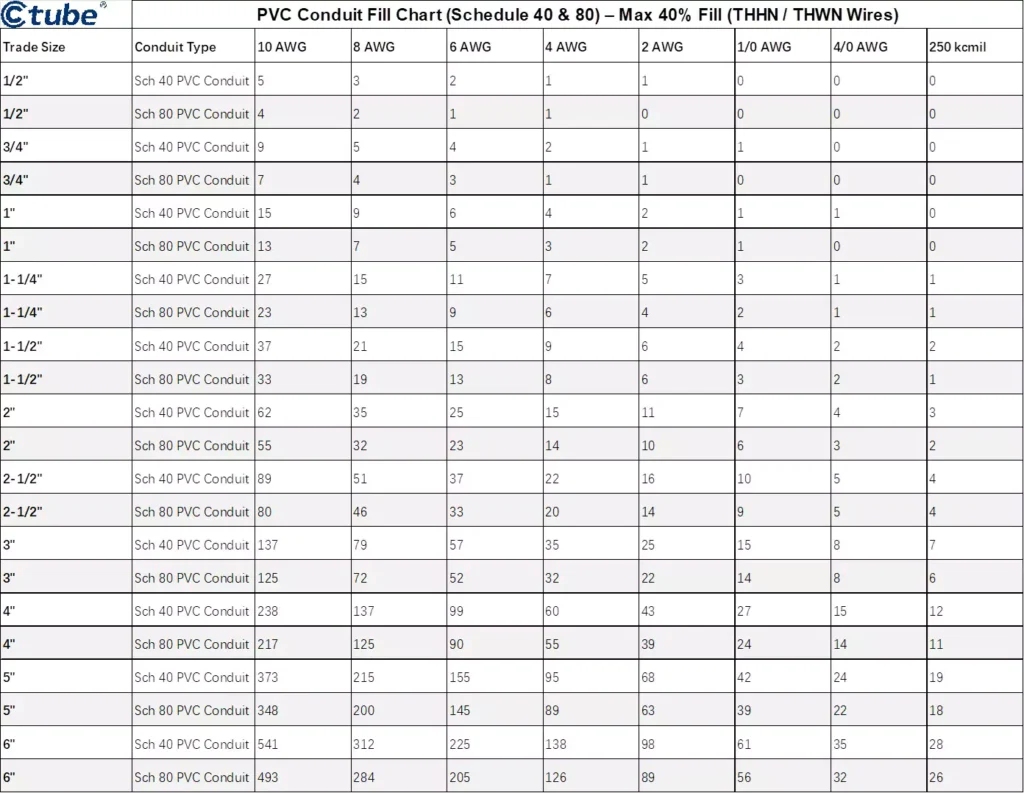
For contractors needing immediate reference without manual calculation, use our pre-calculated fill charts below for THHN/THWN conductors in standard PVC Schedule 40 & 80 conduits.
PVC Conduit Fill Chart (Schedule 40 & 80) – Max 40% Fill (THHN / THWN Wires)
| Quy mô giao dịch | Loại ống dẫn | 10 AWG | 8 AWG | 6 AWG | 4 AWG | 2 AWG | 1/0 AWG | 4/0 AWG | 250 kcmil |
|---|---|---|---|---|---|---|---|---|---|
| 1/2″ | PVC Sch 40 | 5 | 3 | 2 | 1 | 1 | 0 | 0 | 0 |
| 1/2″ | PVC Sch 80 | 4 | 2 | 1 | 1 | 0 | 0 | 0 | 0 |
| 3/4″ | PVC Sch 40 | 9 | 5 | 4 | 2 | 1 | 1 | 0 | 0 |
| 3/4″ | PVC Sch 80 | 7 | 4 | 3 | 1 | 1 | 0 | 0 | 0 |
| 1″ | PVC Sch 40 | 15 | 9 | 6 | 4 | 2 | 1 | 1 | 0 |
| 1″ | PVC Sch 80 | 13 | 7 | 5 | 3 | 2 | 1 | 0 | 0 |
| 1-1/4″ | PVC Sch 40 | 27 | 15 | 11 | 7 | 5 | 3 | 1 | 1 |
| 1-1/4″ | PVC Sch 80 | 23 | 13 | 9 | 6 | 4 | 2 | 1 | 1 |
| 1-1/2″ | PVC Sch 40 | 37 | 21 | 15 | 9 | 6 | 4 | 2 | 2 |
| 1-1/2″ | PVC Sch 80 | 33 | 19 | 13 | 8 | 6 | 3 | 2 | 1 |
| 2″ | PVC Sch 40 | 62 | 35 | 25 | 15 | 11 | 7 | 4 | 3 |
| 2″ | PVC Sch 80 | 55 | 32 | 23 | 14 | 10 | 6 | 3 | 2 |
| 2-1/2″ | PVC Sch 40 | 89 | 51 | 37 | 22 | 16 | 10 | 5 | 4 |
| 2-1/2″ | PVC Sch 80 | 80 | 46 | 33 | 20 | 14 | 9 | 5 | 4 |
| 3″ | PVC Sch 40 | 137 | 79 | 57 | 35 | 25 | 15 | 8 | 7 |
| 3″ | PVC Sch 80 | 125 | 72 | 52 | 32 | 22 | 14 | 8 | 6 |
| 4″ | PVC Sch 40 | 238 | 137 | 99 | 60 | 43 | 27 | 15 | 12 |
| 4″ | PVC Sch 80 | 217 | 125 | 90 | 55 | 39 | 24 | 14 | 11 |
| 5″ | PVC Sch 40 | 373 | 215 | 155 | 95 | 68 | 42 | 24 | 19 |
| 5″ | PVC Sch 80 | 348 | 200 | 145 | 89 | 63 | 39 | 22 | 18 |
| 6″ | PVC Sch 40 | 541 | 312 | 225 | 138 | 98 | 61 | 35 | 28 |
| 6″ | PVC Sch 80 | 493 | 284 | 205 | 126 | 89 | 56 | 32 | 26 |
2.2.Need to source this PVC conduit?
Now that you have your dimensions, ensure your project meets the highest standards of durability and compliance. As a factory-direct manufacturer, we provide the full range of UL-listed PVC conduits, including Schedule 40, Schedule 80, and DB series, ready for bulk shipping. Get Factory Bulk Pricing Today!
3. Understanding Conduit Sizes and Standards
Before we dive into conduit size charts and wire calculations, let’s take a step back to understand conduit sizes.
If you’ve ever bought a pair of shoes from another country, you’ve probably noticed the sizes don’t always match what you’re used to.
A US size 9 isn’t the same as a European size 43, even though they’re for the same foot. The same thing happens with electrical conduit sizes.
3.1 What Is a Conduit Trade Size?
Conduit sizes are usually given in something called a “trade size.” This is like the label size, not the exact measurement.
For example, a 1-inch conduit (trade size) doesn’t have an inner or outer diameter that measures exactly 1 inch. That’s because trade sizes are more of a standard naming system used in the industry to simplify things—not precise measurements.
3.2 Actual Diameter vs Trade Size
Think of it this way: if the trade size is the name of a pizza (“large”), the actual diameter is how big the pizza really is (like 12 inches). The name helps you order, but the exact size can still vary.
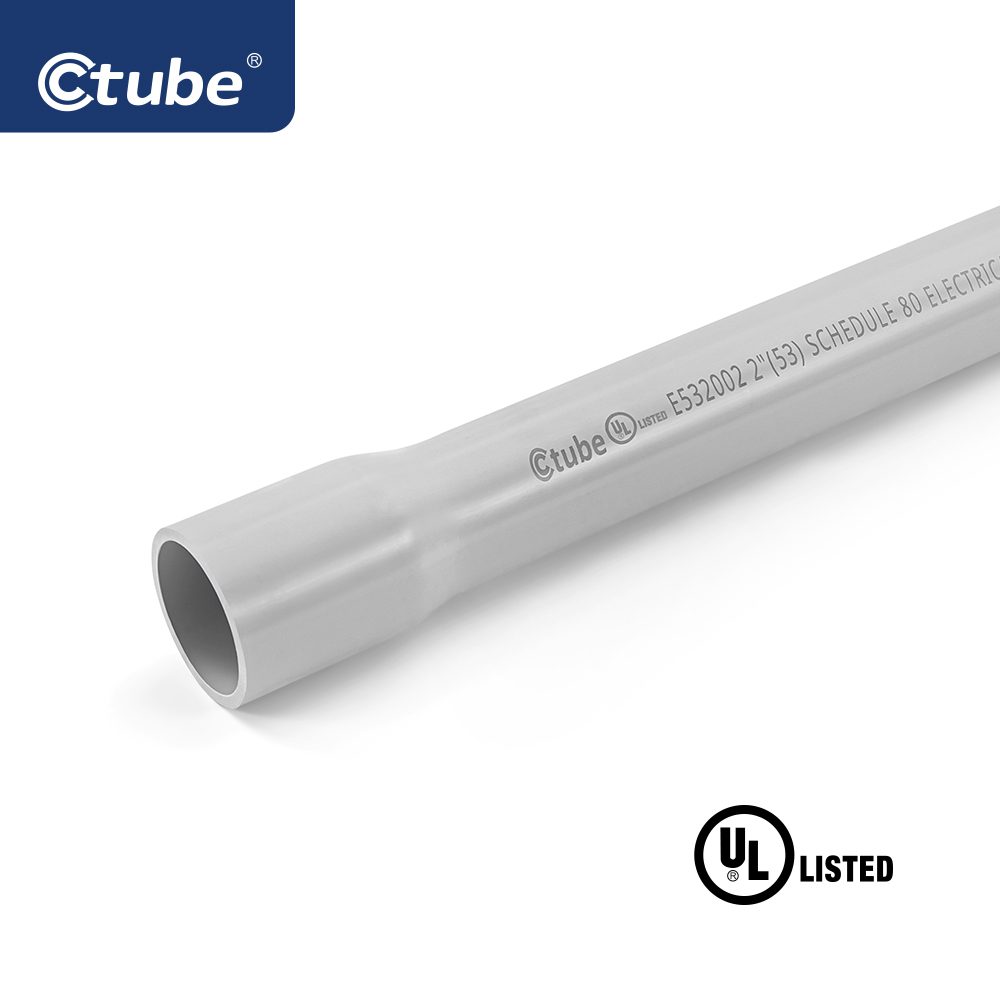
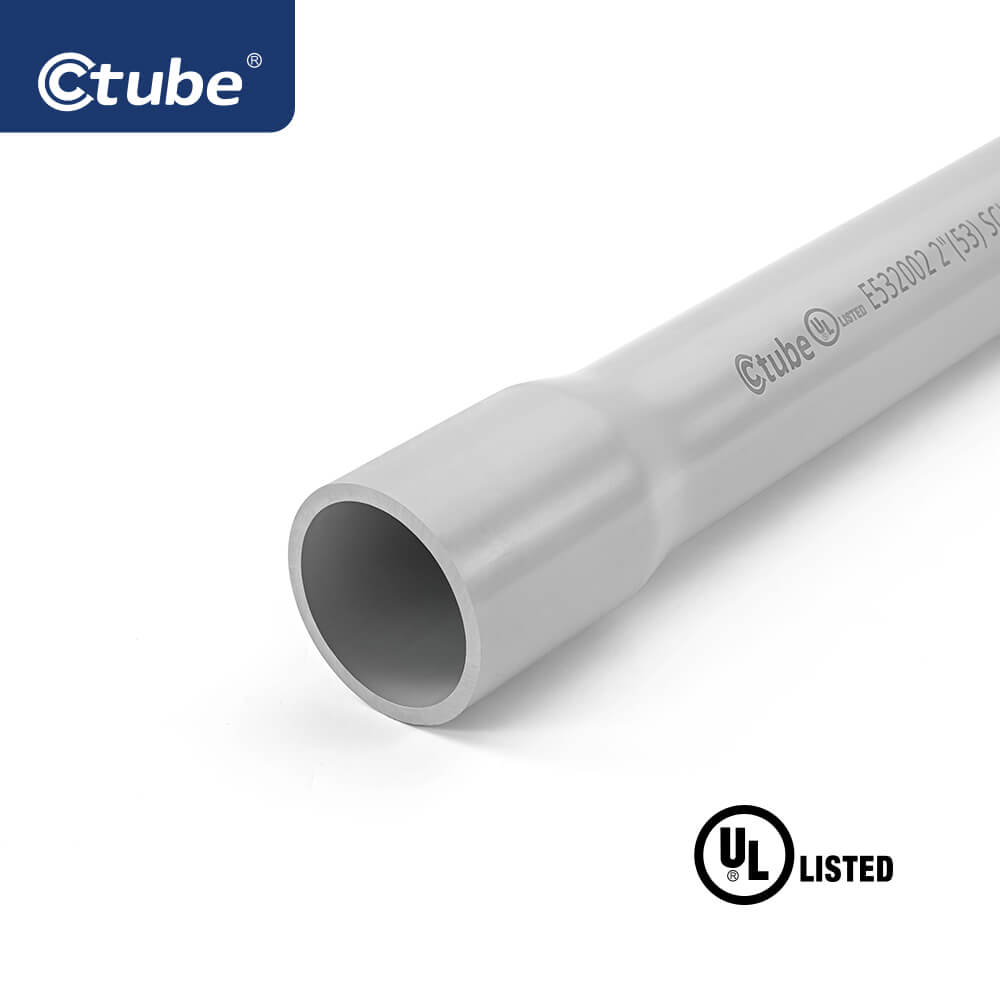
A 1-inch Schedule 40 PVC conduit of Ctube, for example, has an actual outer diameter of about 1.315 inches (33.4 mm).
A 1-inch metal conduit may have slightly different dimensions.
Different types of conduit (PVC, EMT, RMC, flexible metal, etc.) have different wall thicknesses, so even if they have the same trade size, the inner space (where the wires go) may differ.
3.3 Inches vs Millimeters: Regional Differences
Depending on where you are, conduit sizes might be listed in inches or millimeters:
In the U.S. and Canada, conduit sizes are mostly in inches (e.g., ½”, ¾”, 1″).
In many other parts of the world, especially Asia and Europe, metric sizes are common (e.g., 20mm, 25mm, 50mm).
4. Factors That Influence Electrical Conduit Size Selection
Now that we’ve covered the basics of conduit sizes, it’s time to look at what actually affects your choice.
Choosing the right conduit isn’t just about picking something that “looks big enough.” It depends on what’s going inside the conduit, where it’s being installed, and what it’s made of.
In this section, we’ll walk through the key factors you need to consider to ensure safe, code-compliant, and efficient conduit sizing.
4.1 Number and Type of Conductors
Think of electrical wires inside a conduit like people in an elevator. The more people you try to fit, the more crowded—and potentially unsafe—it becomes.
Similarly, the number and type of conductors (wires) inside a conduit directly impact how much space you need. The more conductors you plan to run, the bigger the conduit must be.
🧵 Solid vs. Stranded Wires: Stranded wires take up more space because of tiny air gaps between strands.
📏 Different wire gauges: Thicker wires need more room.

➡️ Detailed explained:
- Solid wire is a single, solid piece of metal. It’s compact and doesn’t take up much space.
- Stranded wire is made up of many thin strands twisted together. These strands create small air pockets, making the wire slightly thicker overall.
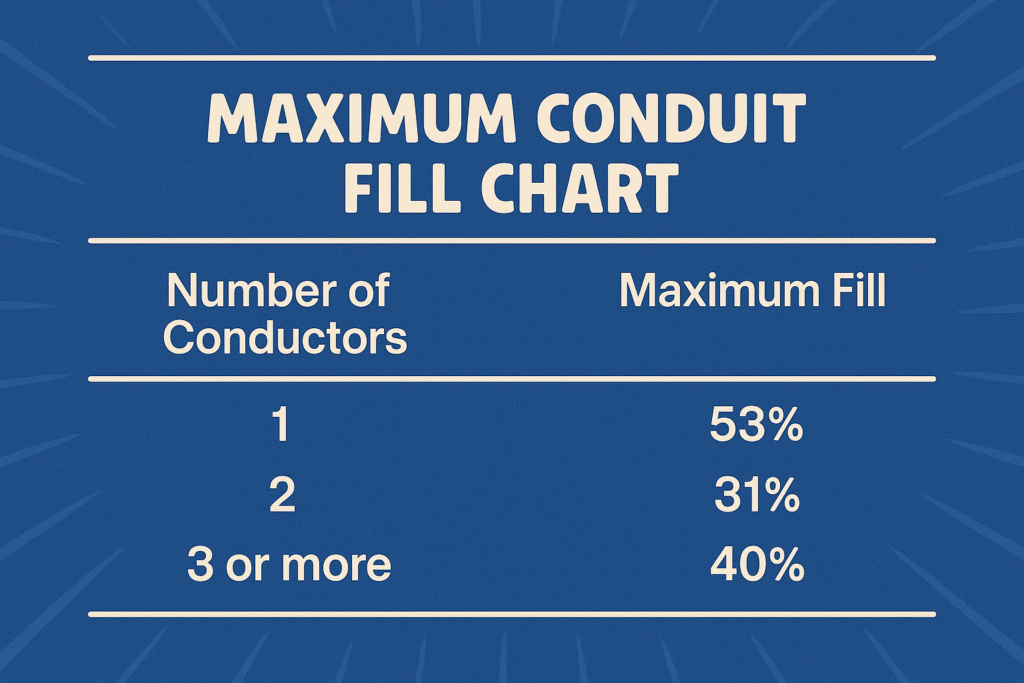
🧮 According to NEC Conduit Fill Table provide the Common Sizes and fill percentages (NEC Chapter 9Table 1)
- 1 wire: max 53% fill
- 2 wires: max 31% fill
- 3 or more wires: max 40% fill
4.2 Conductor Insulation and Voltage Rating
Not all wire insulation is created equal. Some types, like THHN or XHHW, are thinner, while others are thicker for higher voltage or better protection. The thicker the insulation, the more space each wire takes up.
Also, high-voltage wires may need more spacing between conductors, depending on code requirements and safety margins, which affects how large the conduit needs to be.
💡 Imagine each wire wearing a jacket—the thicker the jacket, the more room it takes up. And if that wire carries more voltage, the jacket needs to be thicker for safety.
4.3 Conduit Material and Conduit Types
PVC, metal, RTRC (fiberglass conduit), HDPE, —each type of conduit has different wall thicknesses, which means different interior diameters, even if the trade size is the same.
For example, same sizes PVC Schedule 40 has a larger inner space than Schedule 80 because the walls are thinner.
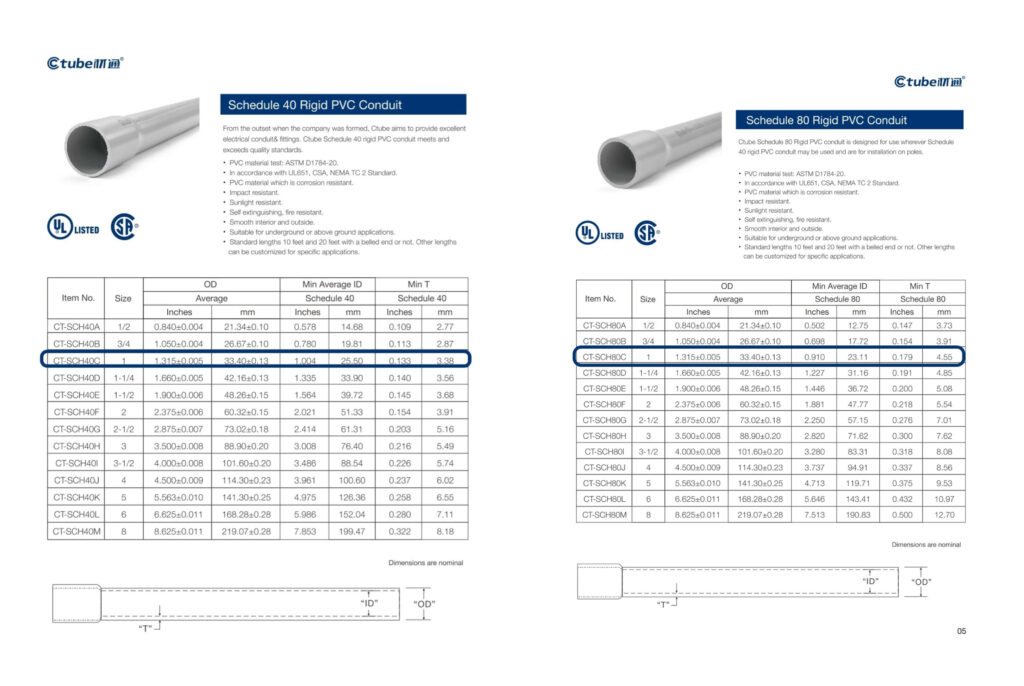
Rigid metal conduits (RMC) have thicker walls than EMT (Electrical Metallic Tubing), so you get less space inside even if the trade size is the same.
Same sizes PVC rigid conduit may be have a smaller inner space than Electrical Metallic Conduit (EMT) for its thinner wall thickness.
💡 It’s important to note that flexible conduit and rigid conduit have different designs. Even they are made from same material and labeled the same size, their actual internal space can be very different.
Rigid conduit is stiff and holds its shape, so the internal space is more consistent and predictable.
Flexible conduit, on the other hand, is bendable and made from a coiled material, which means it has tiny gaps and spaces between the coils.
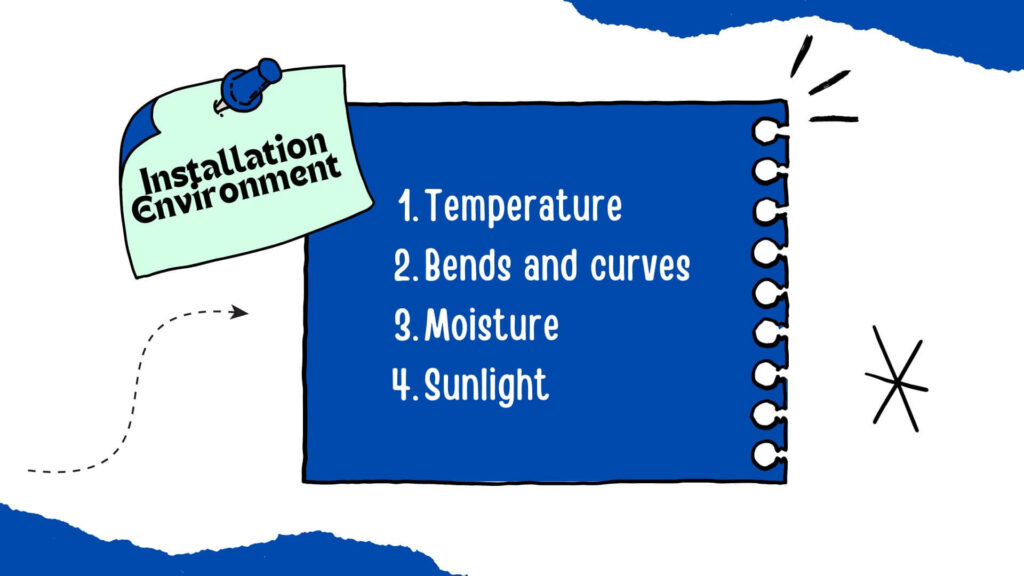
4.4 Installation Environment: Temperature, Bends, Moisture, and Sunlight Exposure
Temperature: High-heat environments may require larger conduit for better ventilation.
Bends and curves: Wires are harder to pull through tight bends. A slightly larger conduit can make the pull smoother and avoid damage.
Moisture: In wet or underground areas, you may need sealed PVC or corrosion-resistant conduits.
Sunlight: UV exposure can weaken some plastics, so UV-rated materials may be needed.
The tougher the environment, the more likely you’ll need to upsize for safety and ease of maintenance.
5. How to Use Fill Chart and Calculate Electrical Conduit Size
Now that we’ve gone through the basic rules and charts, let’s look at how this all works in real life.
5.1 Guideline for Conduit Size Choosing and Fill Chart Usage
📌 You Can Use Different Methods Depending on the Situation
👉 Option 1: Use a Conduit Fill Chart
This is the easiest and fastest way. Just look up your wire type and size, and the chart tells you what size conduit will work. It’s perfect for common wire setups and quick jobs.
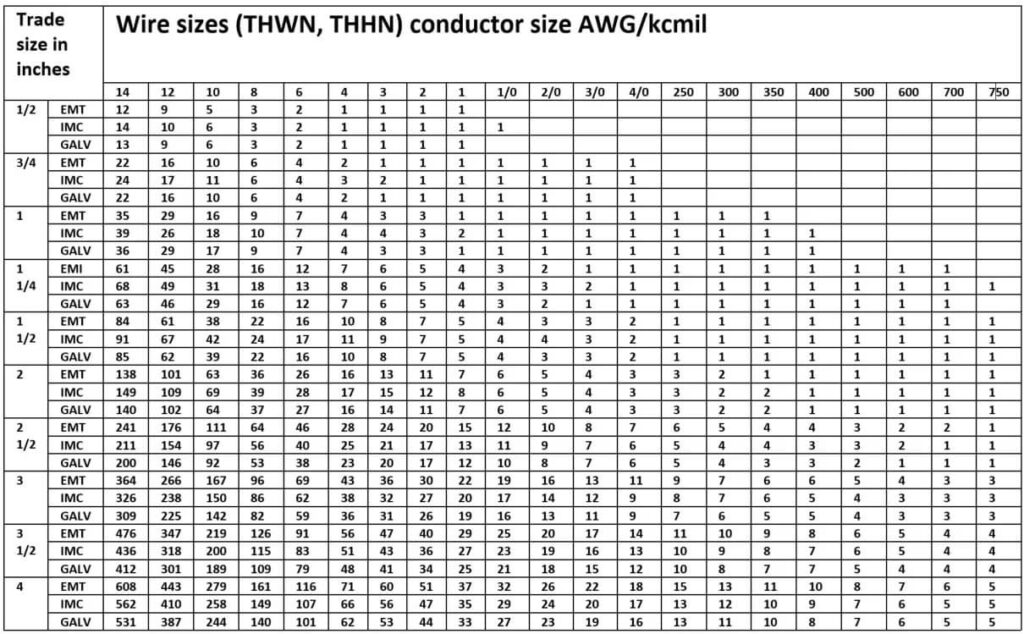
For on-site quick reference, save our PVC Conduit Fill Chart image below, or use the detailed data table for precise engineering checks.
👉 Option 2: Do the Math Manually
This is a better choice when you have multiple wire sizes, special conditions, or need a very accurate result.
💡 If you decide to calculate it manually – whether you’re trying to figure out how many wires fit in a conduit, or which conduit size you need, we’ve got a simple method for you to calculate conduit fill.
💡 Bước 1: Figure out what kind of wires you’re using. That includes the wire size (called gauge), insulation type (like THHN), and how many wires you need to run.
💡 Bước 2: Know what kind of conduit you’re using. EMT, RMC, and PVC conduit all have different inner space, even if they’re the same “size.”
💡 Bước 3: Look up the wire’s size in NEC Table 5 to find the space (area) it takes up. Then, check NEC Chapter 9, Table 4 or Annex C to see how many of that wire can fit in your conduit type and size.
💡 Bước 4: Make sure you don’t go over the “fill limit.”(Table above) For most cases, you shouldn’t fill more than 40% of the space inside the conduit when running more than two wires.
📌Depending on your situation—like the number of wires, their type, and the conduit material—the exact steps might vary slightly.
For example, calculating fill for a single wire type is simpler than figuring out a mixed group of wires or planning a multi-voltage system.
Here we make some examples for you to better understand.
5.2 Example 1: How Many #10 THHN Wires in 3/4″ EMT? (single conductor)
🟢 First Method: Using a Conduit Fill Chart
This method is much quicker because it uses a chart that already does the math for you.
- You just need to:
- Look up the conduit size you’re using (e.g., 3/4″ EMT).
- Find the wire size (e.g., #10 THHN) in the chart.
- The chart will tell you exactly how many of those wires can fit in the conduit, based on its size.
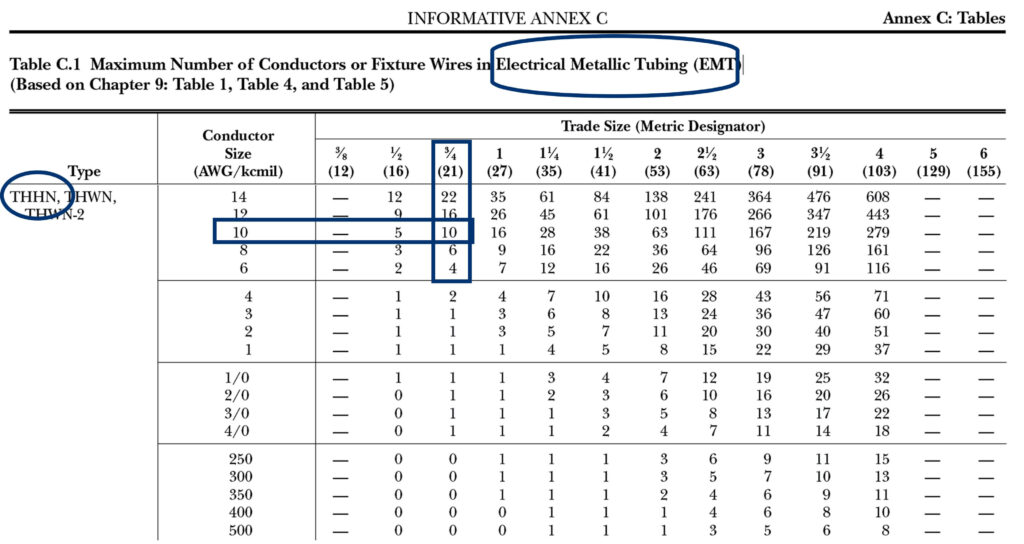
It’s like using a shortcut—just find your size and wire type, and the chart gives you the answer instantly! No need for calculations.
🔴 Second Method: Manual Calculation Using Steps
Step 1: Find the area of one #10 THHN wire
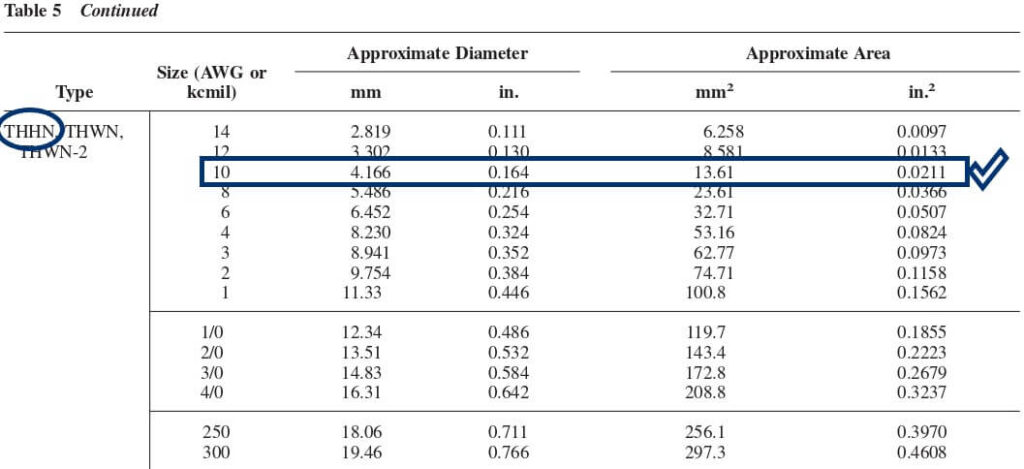
We’ll start by looking at NEC Table 5 to determine the area of a #10 THHN wire.
According to this table, the area for a single #10 THHN wire is 0.0211 square inches.
Bước 2: Xác định diện tích lấp đầy cho phép của ống EMT ¾”
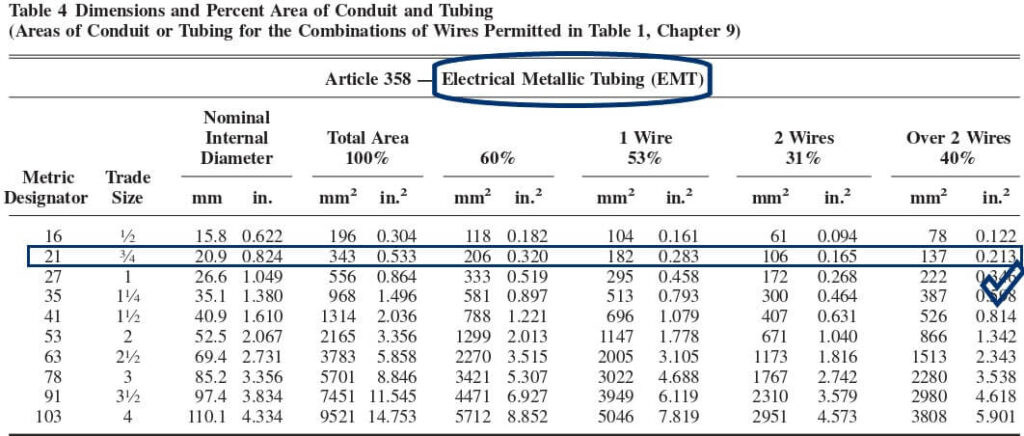
Tiếp theo, chúng ta tham khảo Bảng 4 hoặc Phụ lục C của NEC để biết dung tích chứa của ống dẫn EMT 3/4″.
Đối với ống dẫn điện EMT 3/4″, diện tích khả dụng là 0,533 inch vuông.
Giới hạn đổ đầy của 40% = 0,533 × 0,40 = 0,2132 in²
Bước 3: Chia để tìm số lượng dây phù hợp
0,2132 ÷ 0,0211 ≈ 10,1
✅ Điều đó có nghĩa là bạn có thể an toàn luồn tối đa 10 dây THHN #10 trong ống dẫn EMT ¾” khi tuân theo quy tắc lấp đầy 40%.
🔍 Bạn có thể thấy loại dây được ghi là THHN — đó là loại vật liệu cách điện, được thiết kế cho các hệ thống lắp đặt ở nhiệt độ cao, khô ráo và thường được sử dụng bên trong ống dẫn.
5.3 Giới thiệu và ví dụ về cách bố trí đường dây điện phức tạp hơn
- Trong ví dụ vừa rồi, mọi thứ khá đơn giản:
- Chúng tôi chỉ sử dụng một loại dây dẫn duy nhất: #10 THHN
- Tất cả các dây dẫn đều có cùng kích thước và loại.
- Không có khúc cua gấp hay yêu cầu lắp đặt đặc biệt nào.
Nhưng trong thực tế, mọi chuyện có thể phức tạp hơn.

📌 Dưới đây là lý do tại sao việc lấp đầy ống dẫn có thể trở nên phức tạp trong các tình huống thực tế:
- Bạn có thể có các loại dây dẫn với kích thước hoặc loại vật liệu cách điện khác nhau (ví dụ như trộn dây THHN với dây XHHW).
- Một số dây dẫn có thể mang điện áp khác nhau, điều đó có nghĩa là chúng cần được tách biệt.
- Các đoạn dây dài có thể cần thêm không gian để giảm lực kéo căng.
- Nếu ống dẫn có nhiều khúc uốn hoặc ngoằn ngoèo, việc luồn dây điện qua có thể khó khăn hơn, vì vậy có thể cần ống dẫn lớn hơn.
- Đôi khi cần có thêm không gian trong đường ống để mở rộng trong tương lai hoặc để dễ bảo trì hơn.
💡 Đó là lý do tại sao trong các dự án phức tạp hơn, việc tính toán không phải lúc nào cũng đơn giản.
Bạn có thể cần phải:
- Hãy xem xét nhiều bảng NEC khác nhau (như Bảng 5, Bảng 8 và Phụ lục C).
- Cộng tổng diện tích mà mỗi loại dây dẫn chiếm dụng.
- Hoặc sử dụng công cụ tính toán dung tích ống dẫn trực tuyến để đảm bảo bạn luôn tuân thủ giới hạn an toàn.
👉 Tóm lạiCàng nhiều loại dây dẫn hoặc điều kiện đặc biệt, bạn càng cần tính toán cẩn thận hơn.
Ví dụ 2: Bạn đang kéo dây từ bảng điện chính đến bảng điện phụ trên quãng đường dài 60 feet trong một tòa nhà thương mại.
- 3 dây dẫn #6 THHN (dành cho mạch 240V)
- 1 Dây THHN #10 dùng để nối đất
- 2 dây điều khiển: #12 XHHW
- Ống dẫn sẽ có hai khúc uốn 90 độ.
- Bạn nên sử dụng ống dẫn PVC 1 inch (Schedul 40).
📌 Hướng dẫn từng bước
Bước 1. Liệt kê các loại dây dẫn và kiểu dây của chúng.
- 3x #6 THHN
- 1x #10 THHN
- 2x #12 XHHW
Mỗi loại có kích thước và khả năng cách nhiệt khác nhau, vì vậy chúng chiếm diện tích khác nhau.
Bước 2. Tra cứu diện tích mặt cắt ngang của từng sợi dây.
Trích từ Bảng 5 của NEC:
- #6 THHN ≈ 0,0507 in²
- #10 THHN ≈ 0,0211 in²
- #12 XHHW ≈ 0,0181 in²

Tiếp theo là chiếc XHHW.
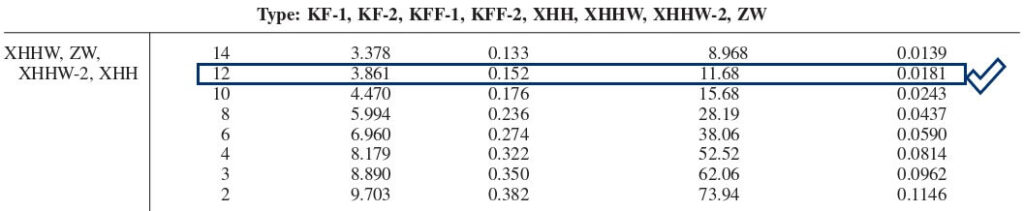
Bây giờ, hãy nhân mỗi số với số lượng:
- 3 x 0,0507 = 0,1521 in²
- 1 x 0,0211 = 0,0211 in²
- 2 x 0,0181 = 0,0362 in²
- Tổng diện tích dây dẫn = 0,2245 in²
Bước 3. Tra cứu dung tích cho phép của ống dẫn PVC 1 inch.
Theo tiêu chuẩn NEC: 40%, thể tích lấp đầy cho hơn 2 dây dẫn trong ống PVC 1 inch là 0,333 in²
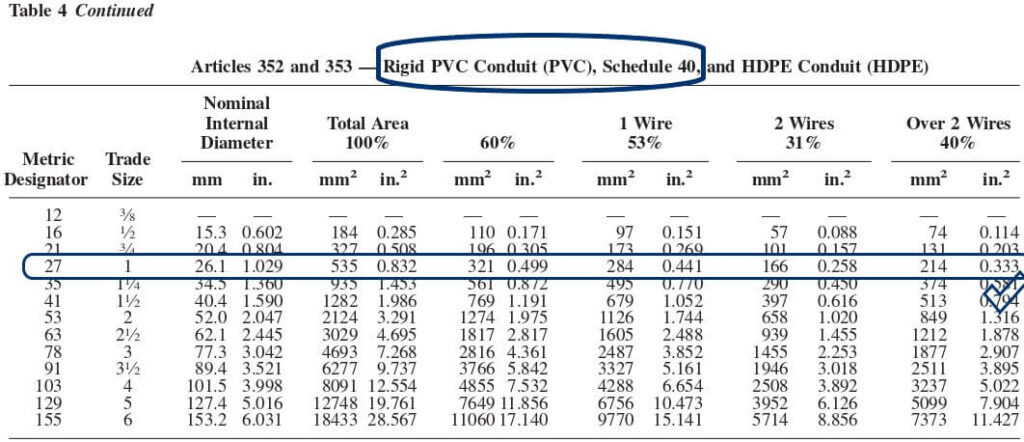
4. So sánh tổng diện tích dây dẫn với dung lượng ống dẫn.
- Tổng diện tích dây dẫn = 0,2245 in²
- Giới hạn lấp đầy của ống PVC 40% 1″ = 0,333 in²
✅ Bạn đang tuân thủ các giới hạn cho phép — vì vậy nó an toàn!
🔎 Nhưng còn nhiều điều khác cần suy nghĩ:
- Vì có hai khúc uốn 90°, việc luồn dây điện qua sẽ khó hơn.
- Bạn có thể muốn chuyển sang sử dụng ống dẫn 1¼” để việc lắp đặt dễ dàng hơn.
- Hoặc sử dụng những khúc cua rộng thay vì những khúc cua gấp.
5.4 Ví dụ 3: Kích thước ống dẫn điện phù hợp cho hệ thống điện 200 Amp (Sử dụng ống dẫn #3/0 THHN)
✅ 2 dây nóng + 1 dây trung tính + 1 dây nối đất = 4 dây cho hệ thống điện 200 Amp.
🔴 Bước 1: Tìm khu vực đổ dây
Theo bảng 5, chương 9 của NEC, một dây dẫn THHN #3/0 chiếm diện tích 0,2679 in².
- 2 dây nóng
- 1 dây trung tính
- 1 dây nối đất (Giả sử bây giờ là #4 THHN, có diện tích là 0,0824 in², theo biểu đồ.)
Vậy tổng diện tích là:
- 3 × 0,2679 in² = 0,8037 in²
- 1 × 0,0824 in² = 0,0824 in²
- Tổng cộng = 0,8858 in²
🔴 Bước 2: Áp dụng quy tắc lấp đầy ống dẫn
Bạn đang sử dụng nhiều hơn hai dây dẫn, vì vậy theo Bảng 1 của NEC, dung tích tối đa được phép chứa trong ống dẫn là 40%.
Bây giờ chúng ta cần tìm một ống dẫn có thể tích lấp đầy 40% ít nhất là 0,8858 in².
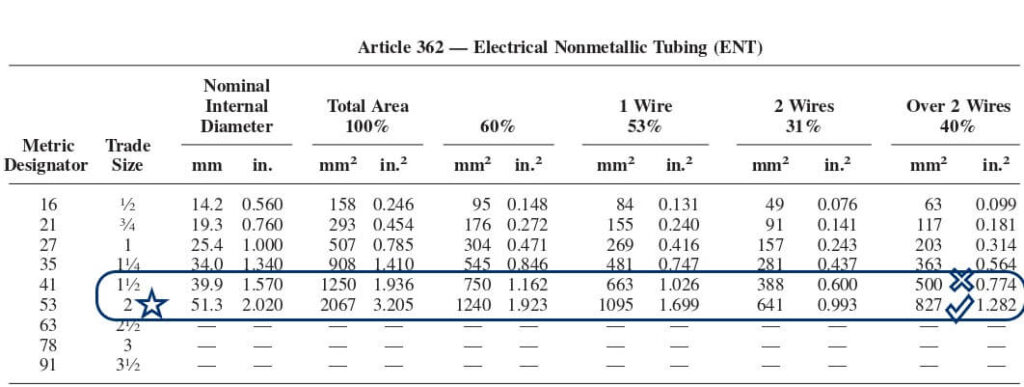
Hãy thử dùng ống dẫn điện EMT 1,5 inch: Tổng thể tích: 0,774 in² ở mức độ đầy 40%
Như vậy vẫn chưa đủ (vì 0,794 < 0,8858)
Hãy thử dùng ống thông y tế EMT 2 inch: Tổng thể tích: 1,282 in² với mức độ đầy 40%
Như vậy là đủ rồi (vì 1,282 > 0,8858)
✅ Trả lời: Bạn có thể sử dụng 2 EMT Ống dẫn điện cho hệ thống 200 ampe này với dây dẫn THHN 3/0.
💡 Giải thích cho bạn, Nếu bạn đang nhầm lẫn giữa 200 ampe và dây THHN 3/0.
✅ 1. Dòng điện 200 Ampe quyết định kích thước dây dẫn
Chúng ta không thể chỉ đoán xem nên dùng loại dây nào — chúng ta phải chọn kích thước dây dựa trên lượng dòng điện (ampe) mà hệ thống cần tải.
Ampe (viết tắt của ampere) dùng để đo cường độ dòng điện.
Trong trường hợp này, 200 ampe là lượng điện mà hệ thống của bạn cần phải xử lý.
Theo NEC (Bộ luật Điện quốc gia), kích thước dây dẫn thông dụng để truyền tải dòng điện 200 ampe một cách an toàn là #3/0 (được đọc là “ba số không”). .
Dây dẫn #3/0 là loại dây dẫn có tiết diện lớn, đủ khả năng chịu tải 200 ampe.
✅ 2. Kích thước dây dẫn quyết định kích thước ống dẫn
Khi bạn đã biết loại và kích thước dây dẫn—ví dụ như #3/0 THHN—bạn có thể tra cứu đường kính và diện tích mà nó chiếm dụng.
Hãy cộng tổng diện tích mà tất cả các dây dẫn chiếm dụng. Sau đó, dựa trên giới hạn dung tích ống dẫn theo tiêu chuẩn NEC (thường không quá 40% cho hơn hai dây dẫn), chúng ta có thể tính toán kích thước ống dẫn bạn cần.
✅ 3. Tại sao cần 4 dây cho hệ thống điện 200 Amp?
Đôi khi có thể sử dụng 3 dây, nhưng chỉ trong những trường hợp cụ thể — thường là khi ống dẫn hoặc dây cáp bằng kim loại và có thể hoạt động như dây nối đất.
5.5 Ví dụ 3: Nên chọn loại ống dẫn có kích thước nào cho dây dẫn 6/3 (THHN)?
🧐 Trước tiên, “6/3” có nghĩa là gì?
Ký hiệu 6/3 biểu thị một loại cáp có:
- “6” = kích thước dây dẫn (AWG #6)
- “3” = ba dây dẫn mang dòng điện
- Nó thường cũng bao gồm 1 dây nối đất trần, như vậy tổng cộng sẽ có bốn dây bên trong cáp.
- 👉 Như vậy, bạn đang xử lý tổng cộng 4 sợi dây.
Cấu hình này thường thấy ở các thiết bị như máy sấy điện, lò nướng hoặc bảng điện phụ trong các tòa nhà dân cư.
📐 Hướng dẫn từng bước: Cách chọn kích thước ống dẫn phù hợp
✅ Bước 1: Xác định khu vực dây dẫn
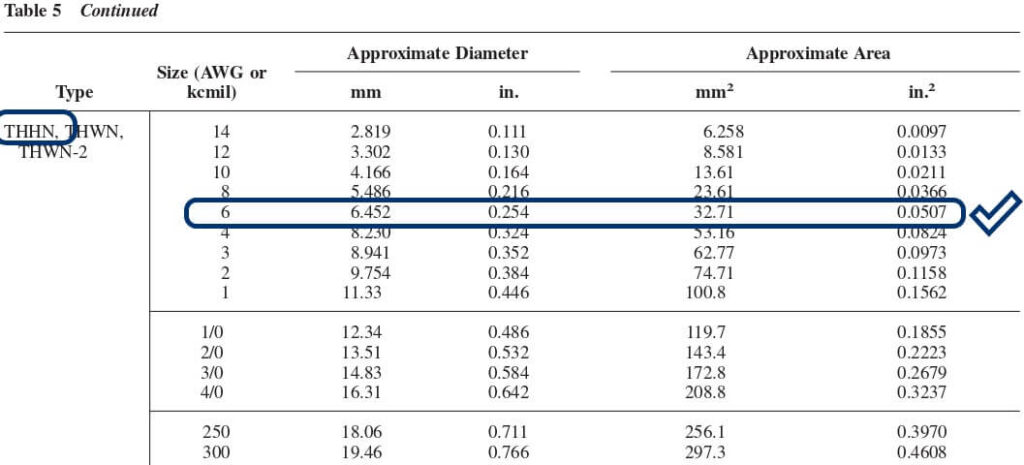
Theo Bảng 5 của NEC, #6 THHN = 0,0507 in² trên mỗi dây dẫn
Tổng diện tích cho 4 dây: 0,0507 × 4 = 0,2028 in²
✅ Bước 2: Áp dụng Quy tắc lấp đầy NEC
Đối với trường hợp có nhiều hơn hai dây dẫn trong ống dẫn, giới hạn tải trọng theo tiêu chuẩn NEC là 40%.
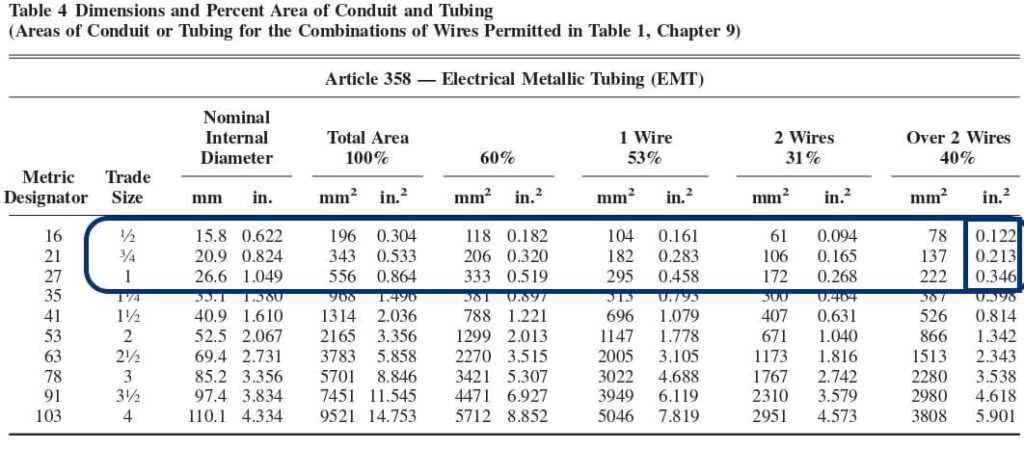
✅ Bước 3: Tìm kích thước phù hợp, ở đây chúng ta kiểm tra bảng kích thước ống dẫn EMT.
| Kích thước EMT | 40% Đổ đầy (tối đa) | Đủ cho 6/3 THHN không? |
| Ống EMT ½” | 0,122 in² | ❌ Không (quá nhỏ) |
| EMT ¾” | 0,213 in² | ✅ Có (phù hợp với diện tích 0,2028 in²) |
| EMT 1″ | 0,346 in² | ✅ Có, với không gian rộng rãi hơn |
6. Crucial Difference: PVC Schedule 40 vs. Schedule 80 Sizing in Real-World MEP Projects
Many electrical contractors make a costly assumption: assuming a 2-inch PVC conduit has the same internal volume regardless of its schedule rating. This is a critical NEC compliance trap.
Because PVC Schedule 80 is engineered with a thicker wall to withstand higher physical impact and crush resistance (in strict accordance with UL 651 Và NEMA TC 2), its Internal Diameter (ID) is significantly smaller than Phụ lục 40.
If you max out the 40% fill capacity based on Schedule 40 calculations, and the site engineer switches to Schedule 80 for high-traffic underground burial, your wires will not fit, leading to massive increases in pulling tension, jacket chafing, and double labor costs.
Here is the exact numerical breakdown for 2″ Trade Size PVC:
| Loại ống dẫn | Đường kính ngoài (OD) | Wall Thickness (Min) | Internal Area (100%) | Max Allowable Fill Area (40% NEC Limit) |
|---|---|---|---|---|
| 2″ PVC Schedule 40 | 2.375 in (60.32 mm) | 0.154 in (3.91 mm) | 3.356 in² | 1.342 in² |
| 2″ PVC Schedule 80 | 2.375 in (60.32 mm) | 0.218 in (5.54 mm) | 2.953 in² | 1.181 in² |
Data referenced from NEC Chapter 9, Table 4. Note the ~12% reduction in usable fill area when upgrading to Sch 80.
6.1 How to Calculate Conduit Fill for Mixed Wire Batches (PVC Sch 40 Example)
Let’s calculate a common commercial run: You are routing a feeder circuit using 2″ PVC Schedule 40. The required conductors are:
- 3x #3/0 AWG THHN (Phase conductors)
- 1x #1 AWG THHN (Neutral)
- 1x #4 AWG THHN (Equipment Grounding Conductor)
Step 1: Cross-Sectional Area Calculation (NEC Table 5)
- #3/0 THHN: 0.2679 in² × 3 = 0.8037 in²
- #1 THHN: 0.1564 in² × 1 = 0.1564 in²
- #4 THHN: 0.0824 in² × 1 = 0.0824 in²
- Total Conductor Area = 1.0425 in²
Step 2: Verification Against PVC Conduit Capacity Comparing the total conductor area (1.0425 in²) to the 2″ PVC Sch 40 max fill limit (1.342 in²), the fill ratio is approximately 31%. This is well below the NEC 40% maximum allowable fill limit.
Contractor Insight: A 31% fill ratio ensures smooth wire pulling, minimizes heat buildup in heavy-load circuits, and drastically reduces the risk of insulation damage during installation.
7. Kết luận
Việc lựa chọn kích thước ống dẫn phù hợp chỉ là bước đầu tiên trong một dự án điện thành công. Độ tin cậy lâu dài của cơ sở hạ tầng – dù là ngầm hay trên mặt đất – phụ thuộc rất nhiều vào chất lượng vật liệu và sự tuân thủ quy định của hệ thống đường ống mà bạn lắp đặt.
Tại Ctube, Chúng tôi không chỉ cung cấp ống dẫn; chúng tôi thiết kế chúng. Là nhà sản xuất chuyên nghiệp các hệ thống đường ống PVC đạt chứng nhận UL, chúng tôi thu hẹp khoảng cách giữa sản xuất hàng loạt và kỹ thuật chính xác. Từ ống dẫn cứng Schedule 40/80 đến ống dẫn tiện ích chuyên dụng Type DB 60/100/120, chúng tôi đảm bảo rằng mọi đoạn ống rời khỏi nhà máy của chúng tôi đều đáp ứng các yêu cầu khắt khe của ngành xây dựng điện hiện đại.
Tại sao nên chọn Ctube cho dự án tiếp theo của bạn?
-
Ưu điểm khi mua trực tiếp từ nhà máy: Loại bỏ chi phí trung gian đồng thời vẫn duy trì kiểm soát chặt chẽ chất lượng sản phẩm.
-
Tuân thủ đầy đủ: Tất cả các sản phẩm của chúng tôi được sản xuất theo tiêu chuẩn ASTM D1784, UL651 và NEMA TC 2.
-
Được thiết kế để có độ bền cao: Đặc tính chống ăn mòn, chống va đập và tự dập lửa đảm bảo công trình của bạn có thể sử dụng được hàng chục năm.
Liên hệ bộ phận bán hàng/Yêu cầu báo giá!
8. More Information for You
💡 Trong bài viết này, chúng tôi giới thiệu định nghĩa về dây dẫn và kích thước dây (AWG) một cách rất chi tiết và dễ hiểu, bạn có thể đọc tùy thích: Hiểu về bảng hướng dẫn dung tích ống PVC: Cẩm nang toàn diện (2025), Bạn có thể tìm hiểu thêm và hiểu rõ hơn các thuật ngữ liên quan mà chúng tôi đã đề cập trong bài viết này.
📝Và nếu bạn muốn tìm hiểu cách đo kích thước ống dẫn điện, bạn có thể xem bài viết này. Cách đo chiều dài và đường kính ống dẫn điện.
🔵 Tại Ctube, chúng tôi chuyên sản xuất ống dẫn và phụ kiện PVC chất lượng cao, được thiết kế cho các hệ thống điện an toàn và hiệu quả.
Sản phẩm của chúng tôi đáp ứng các tiêu chuẩn quốc tế như UL, CSA và AS/NZS 2053, và chúng tôi cung cấp nhiều loại và kích cỡ ống dẫn khác nhau, bao gồm: ống dẫn cứng như Phụ lục 40, Phụ lục 80, DB, EB, ống phi kim loại cách điện và các loạt phim đặc biệt như UPVC năng lượng mặt trời Và ít khói, không chứa halogen tùy chọn.
Dù bạn đang thực hiện dự án nhà ở, thương mại hay công nghiệp, Ctube luôn sẵn sàng hỗ trợ nhu cầu của bạn với các giải pháp đáng tin cậy, được chứng nhận và hướng dẫn chuyên môn.
9. Câu hỏi thường gặp
Does the 40% fill rule apply if I only run a single wire?
No, according to NEC Chapter 9, a single conductor can fill up to 53% of the conduit's cross-sectional area.
What is the fill percentage for two wires in a PVC conduit?
For exactly two conductors, the NEC strictly limits the fill capacity to 31% to prevent jamming during the pull.
Do I need to include the ground wire in my conduit fill calculation?
Yes, every physical conductor, including bare or insulated equipment grounding conductors, must be included in the total fill area.
Is the fill capacity for Schedule 80 the same as Schedule 40 PVC?
No, Schedule 80 has a thicker wall which reduces the internal diameter (I.D.), resulting in a lower wire fill capacity than Schedule 40.
Does the NEC conduit fill rule apply to low-voltage data cables (Cat6)?
While the NEC doesn't legally mandate fill limits for low-voltage PoE/data cables, TIA/EIA standards highly recommend a 40% max fill to prevent signal degradation and cable crushing.
How do I calculate conduit fill for non-circular cables like Romex (NM-B)?
You must treat flat/elliptical cables as a solid circular conductor, using its widest dimension (major diameter) to calculate the cross-sectional area.
Can I mix different wire sizes (e.g., 10 AWG and 4 AWG) in the same conduit?
Yes, but you cannot use a standard chart; you must manually calculate the sum of the cross-sectional areas of each individual wire and ensure it stays under the 40% limit.
What causes wire jamming in PVC conduits?
Jamming typically occurs when the sum of the outer diameters of three conductors is between 2.8 and 3.2 times the internal diameter of the conduit.
Does conduit bending affect the allowable fill percentage?
The 40% rule remains unchanged, but multiple 90-degree bends significantly increase pulling tension, meaning you might need to upsize the conduit to avoid wire damage.
Do I calculate fill capacity using the nominal size or actual internal diameter?
Calculations must always be based on the precise actual internal diameter (I.D.) listed in NEC Chapter 9, Table 4, not the trade/nominal size.
What happens if I exceed the 40% maximum fill limit?
Exceeding the limit causes severe heat buildup (preventing heat dissipation), damages wire insulation, and will result in a failed inspection.
Are the fill charts the same for ENT (Smurf Tube) and Rigid PVC?
No, Electrical Nonmetallic Tubing (ENT) has different interior dimensions compared to Rigid PVC (Sch 40/80) and requires its own specific fill calculations.
Does ambient temperature affect the conduit fill limit?
Ambient temperature does not change the physical 40% fill limit, but it does require you to derate the ampacity of the conductors inside.
Is pulling lubricant required if I stay under the 40% fill limit?
Tiêu chuẩn NEC không quy định rõ ràng việc sử dụng chất bôi trơn, nhưng các nhà thầu rất khuyến khích sử dụng chất bôi trơn cho bất kỳ đường ống PVC nào có độ dày gần 35% để giảm ma sát thành ống.
Why does my calculated fill differ slightly from online calculators?
Các công cụ tính toán thường sử dụng kích thước tiêu chuẩn trong Bảng 5 của NEC, nhưng đường kính ngoài (OD) chính xác có thể thay đổi đôi chút tùy thuộc vào nhà sản xuất vật liệu cách nhiệt cụ thể.



 English
  French
  Spanish
  German
  Arabic
  Indonesian
  Vietnamese