
1. Introduction
Most outdoor electrical conduit failures don’t happen because the pipe cracked in the sun or rusted away. They happen at the connections—where conduit meets box, where fittings thread together, or where a cover seal was overlooked.
In other words, the weakest link isn’t the conduit itself—it’s the system around it.
True weather resistance comes from how well all components work together: the conduit material, the type of joints, the rating of enclosures, the quality of seals, and even installation technique.
This guide cuts through the noise. Instead of ranking “best conduits,” we’ll show you how to build a reliable, code-compliant outdoor conduit system that stands up to UV, rain, corrosion, temperature swings, and physical stress—by matching the right combination of materials and methods to your specific environment.
Whether you’re wiring a backyard shed, installing rooftop equipment, or working near the coast, you’ll learn what actually matters for long-term performance.
2. Key Environmental Challenges for Outdoor Conduit Systems
Outdoor conduit systems operate in some of the harshest conditions an electrical installation can face. Unlike indoor raceways, they must endure continuous exposure to dynamic environmental forces—often simultaneously. Understanding these stressors is the first step toward building a truly resilient system.
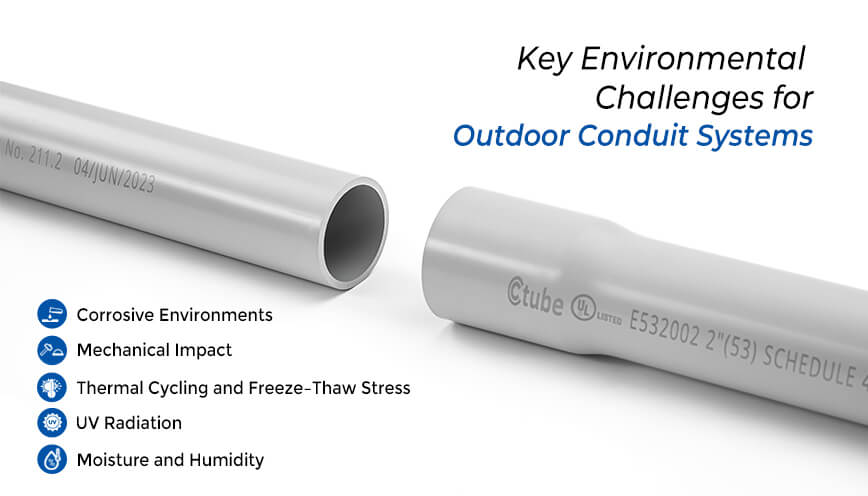
UV Radiation: Sunlight’s ultraviolet rays break down polymer chains in many plastics. Unstabilized PVC, for example, can become brittle within 2–3 years in high-sun regions like the Southwest U.S., leading to cracks under minor impact. Even “outdoor-rated” conduits vary widely in UV resistance—look for products explicitly tested per ASTM G154 or UL 651.
Moisture and Humidity: Water intrusion rarely comes from the conduit body—it sneaks in through unsealed threads, loose set-screw fittings, or non-gasketed box covers. In humid climates or areas with driving rain (e.g., coastal rooftops), moisture can wick into raceways via capillary action, corroding conductors or causing ground faults over time.
Mechanical Impact: Conduits mounted on exterior walls, near service entrances, or in industrial yards are vulnerable to accidental strikes. Thin-wall EMT may dent easily, while improperly supported runs can sag or pull apart at joints.
Corrosive Environments: Salt-laden air within 1–2 miles of the ocean can corrode galvanized steel in under five years. Similarly, chemical plants or pool equipment areas emit chlorides or acids that eat away at metal surfaces—even stainless steel isn’t immune without proper grade selection.
Thermal Cycling and Freeze–Thaw Stress: Daily temperature swings cause expansion and contraction. In cold zones, water that seeps into a fitting can freeze overnight, expanding with enough force to crack PVC or separate threaded connections. Materials with low thermal stability or rigid joint designs are especially at risk.
Critically, these factors compound: a conduit in Miami faces UV + humidity + salt; one in Minnesota battles freeze-thaw + snow load + summer heat. That’s why a component-by-component approach fails—only a coordinated system can handle real-world complexity.
3. Conduit Materials: Matching Properties to Real-World Demands
Choosing a conduit material is not about selecting the “strongest” option—it is about aligning material properties with the environmental and mechanical demands identified earlier. Each conduit type contributes differently to overall system performance, and understanding these roles is essential when designing a weather-resistant exterior installation.
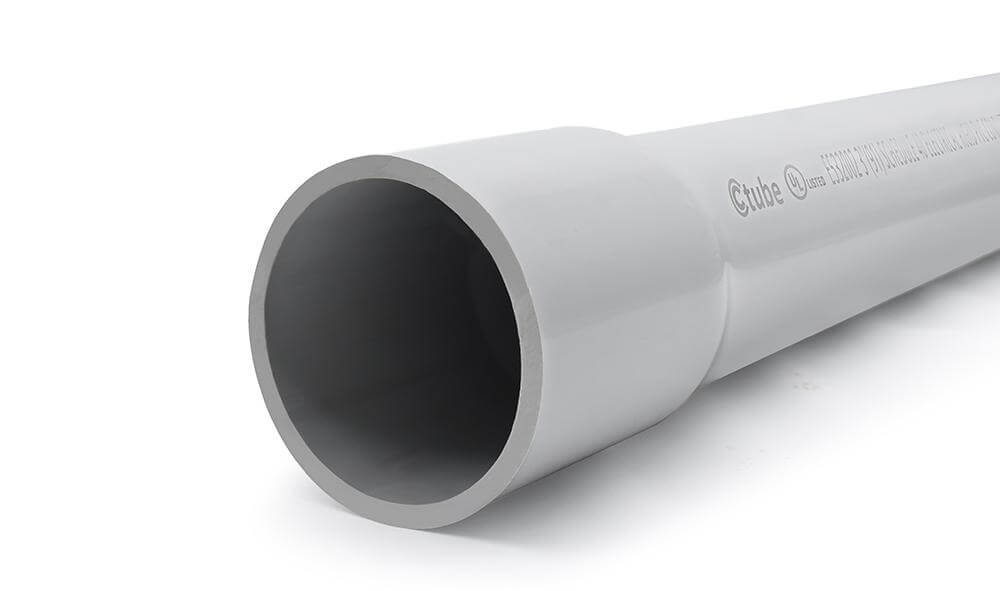
PVC Conduit (Schedule 40 & Schedule 80)
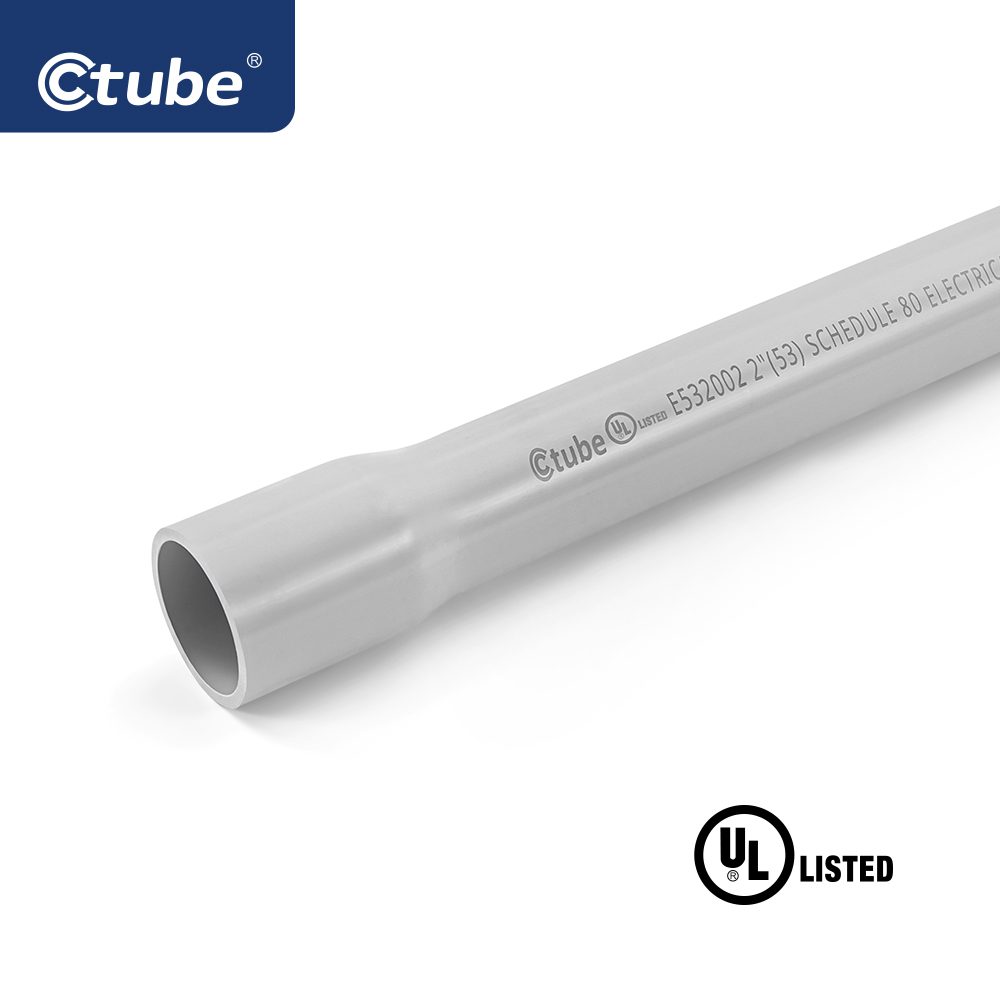
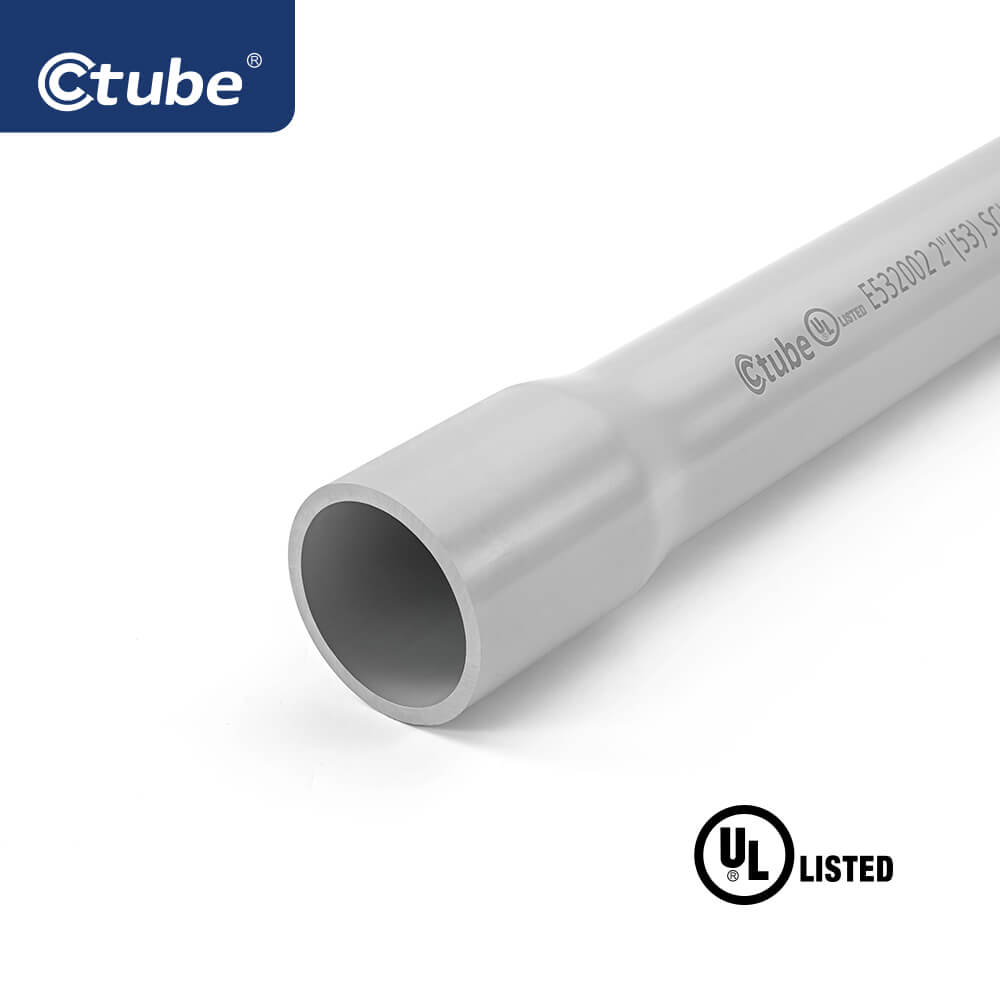
PVC is commonly used for residential and light commercial outdoor installations due to its resistance to moisture and corrosion, relatively low cost, and straightforward installation. Schedule 40 is typically sufficient for protected locations such as under eaves, while Schedule 80 is required where the conduit may be subject to physical damage, as referenced in NEC 352.10(F).
For outdoor use, PVC must be listed as sunlight resistant and comply with UL 651, as non-rated PVC can degrade rapidly under prolonged UV exposure. When solvent-welded correctly, PVC forms a continuous, water-resistant raceway that minimizes leakage points at joints—an important advantage in wet locations.
Within a system, PVC functions best as a sealed, non-corrosive pathway where long-term moisture control is more critical than impact resistance.
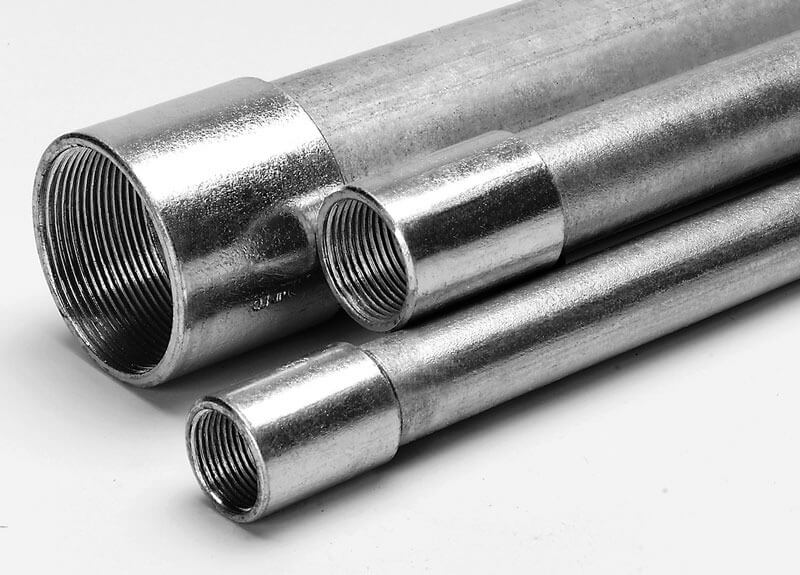
Rigid Metal Conduit (RMC) and Intermediate Metal Conduit (IMC)
RMC and IMC are selected primarily for their mechanical strength and their ability to serve as an equipment grounding conductor. These characteristics make them suitable for service masts, industrial facilities, and areas exposed to potential impact or tampering.
However, metal conduit requires a deliberate corrosion strategy. Standard galvanized finishes may deteriorate quickly in humid or coastal environments, particularly within one mile of saltwater exposure. In these conditions, epoxy-coated conduit or alternative non-metallic systems are often more reliable over time. It is also important to note that EMT is not permitted in wet locations under NEC 358.10(B), a detail that is frequently overlooked.
In system design, metal conduit is best viewed as a protective and grounding component rather than a corrosion-resistant solution.
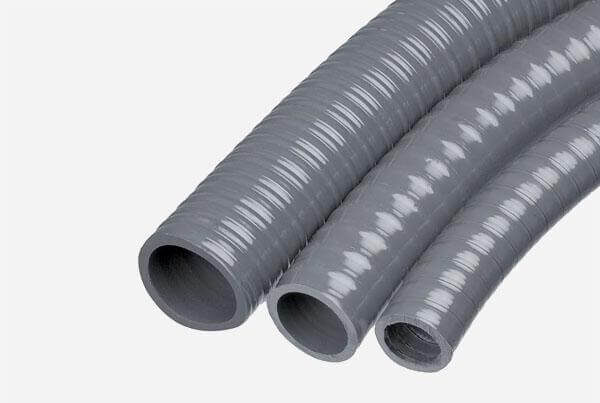
Liquid-Tight Flexible Nonmetallic and Metallic Conduit (LFNC / LFMC)
Liquid-tight flexible conduit is typically used where vibration, movement, or complex routing makes rigid systems impractical, such as at connections to HVAC units, pumps, or generators.
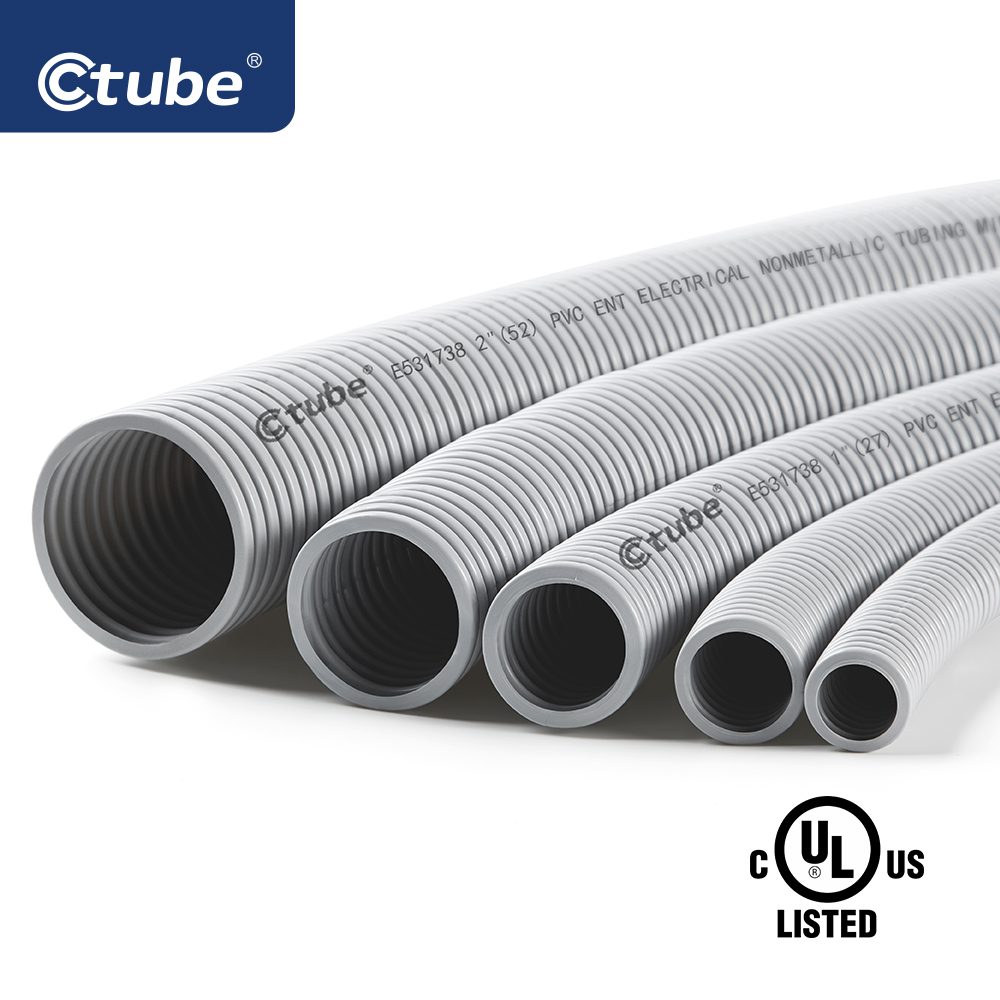
LFNC performs well in high-moisture or corrosive environments due to its nonmetallic construction, while LFMC offers improved crush resistance through its metallic core. In both cases, system performance depends heavily on the use of listed liquid-tight connectors. A single mismatched fitting can compromise the wet-location integrity of the entire run.
Flexible conduit should be treated as a transition element within a system, not as a substitute for a fully rigid raceway.
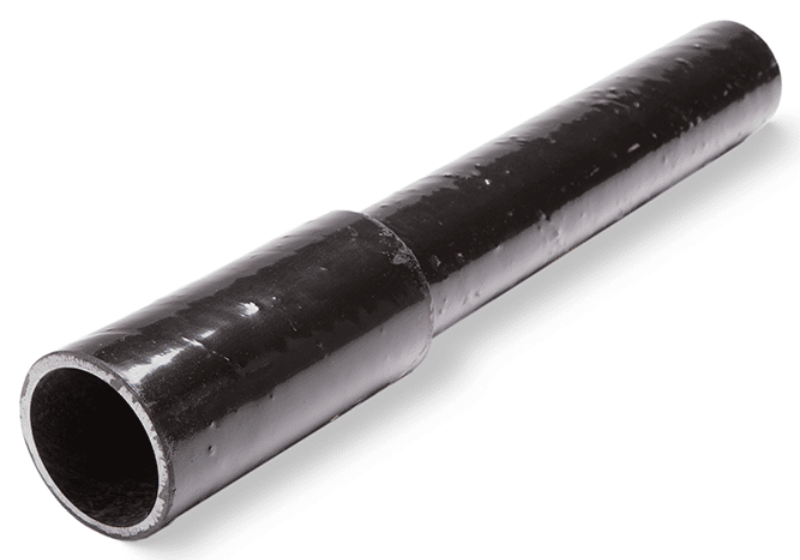
Reinforced Thermosetting Resin Conduit (RTRC / Fiberglass)
RTRC combines the corrosion resistance of nonmetallic materials with structural rigidity comparable to metal conduit. It does not rust, is electrically non-conductive, and—when properly formulated—maintains stability under prolonged UV exposure.
These characteristics make RTRC well-suited for chemical facilities, wastewater treatment plants, and coastal environments. Although it is typically more expensive and less convenient to cut than PVC, its dimensional stability across temperature extremes helps reduce long-term stress at joints. For above-ground outdoor installations, RTRC should be listed to UL 2142, as not all fiberglass conduit is rated for continuous sun exposure.
Within a system, RTRC often serves as a durable backbone where both corrosion resistance and structural integrity are required.
No single conduit material addresses every outdoor challenge. Effective exterior systems are built by allowing environmental conditions to determine the base material, then integrating fittings, enclosures, and installation methods that support that choice.
Material selection is a starting point—not the final determinant of weatherproof performance.
4. Building Top-Performing Weatherproof Conduit Systems by Application
There’s no single “best” conduit for every outdoor project—but there are proven, code-compliant systems tailored to specific environmental conditions. The key to lasting performance is not just the pipe itself, but how all components—conduit, fittings, boxes, and seals—work together as an integrated system. Below, we explore four common application scenarios and the assemblies that reliably address the dominant challenges each faces.

Residential Exterior Wiring (Walls, Patios, Landscape Lighting)
Challenges: UV exposure, occasional mechanical impact, rain and surface moisture
Use Schedule 40 PVC for most exposed runs, opting for Schedule 80 only where physical contact is likely, such as near driveways or garden paths. All joints should be solvent-welded to create a continuous, sealed pathway that prevents water ingress. Pair the conduit with NEMA 3R or 4X weatherproof boxes equipped with neoprene-gasketed covers; avoid set-screw connectors, which can compromise system integrity. Correct support spacing per NEC 352.30 prevents sagging, stress on joints, and long-term failure.
In residential applications, PVC acts as a durable, moisture-resistant backbone that channels wiring safely while maintaining a sealed environment from end to end.
High-Moisture & Rain-Exposed Locations (Rooftops, Washdown Areas)
Challenges: Wind-driven rain, condensation, vapor intrusion
Install fully solvent-glued PVC raceways, avoiding threaded or push-fit joints that can introduce leak paths. Conduits should terminate into wet-location-rated enclosures using hub-style or gasketed conduit bodies to maintain continuous protection. Box covers must be tightly sealed; even minor gaps allow water to track along conduit surfaces during heavy rain.
Here, the PVC raceway acts as a continuous, water-resistant channel, while properly rated enclosures and gasketed fittings form the system’s watertight interface with equipment or branch circuits.
The synergy between materials and enclosure seals defines true weatherproof performance.
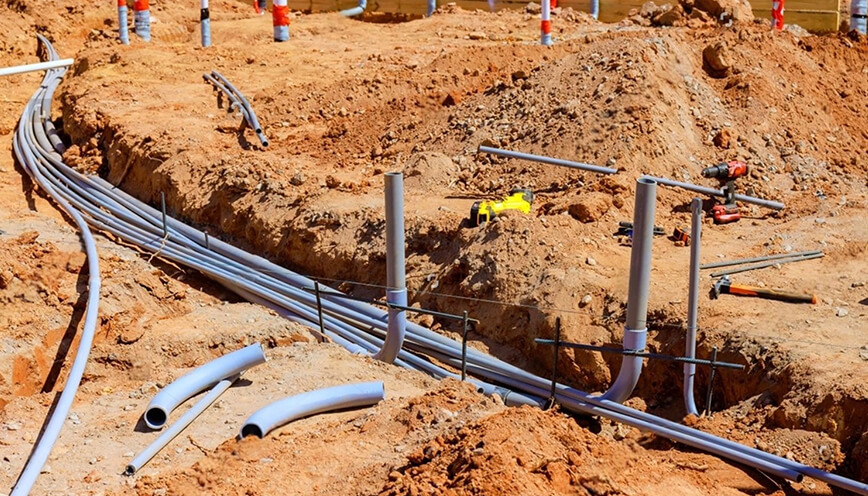
Underground-to-Above-Grade Transitions
Challenges: Soil movement, thermal expansion, capillary moisture, freeze-thaw cycles
Schedule 80 PVC is recommended for above-ground stub-ups, rising at least 18 inches above grade per NEC 300.5(J). Connect to buried conduits using long-radius elbows to reduce stress on wires during installation and daily thermal movement. Expansion fittings are advised for runs exceeding 20 feet in regions with wide seasonal temperature swings. Seal the entry point into the enclosure with duct seal or pourable foam to block moisture wicking from the ground.
In this scenario, PVC provides structural and moisture resistance above ground, while expansion joints and proper sealing maintain system integrity under shifting soil and thermal conditions.
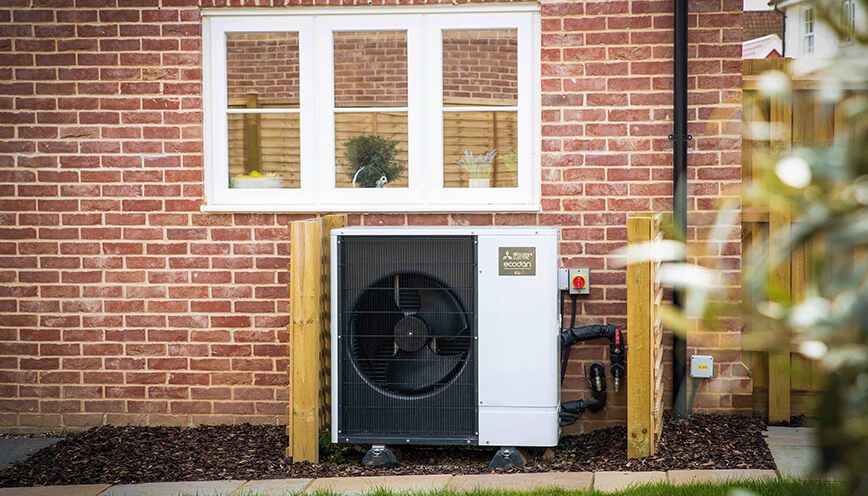
Outdoor Equipment Connections (HVAC, Pumps, Generators)
Challenges: Vibration, alignment shifts, water splashing
Use liquid-tight flexible nonmetallic conduit (LFNC) or liquid-tight flexible metal conduit (LFMC) where movement or vibration occurs. Terminate the conduit into a NEMA 4X enclosure using UL-listed liquid-tight connectors rated for wet locations, ensuring the connector grips both the jacket and the inner core. Maintain minimum bend radii to prevent cracking, and consider strain relief clamps within 12 inches of the connection for high-vibration equipment.
Flexible conduit functions as a transition and motion-compensation component, protecting rigid raceways and equipment connections from dynamic stress without compromising the wet-location integrity of the overall system.
5. Connector & Fittings – Ensuring System-Level Water Resistance
Even the best conduit material can fail to protect wiring if connections and fittings are not properly specified and installed. In outdoor environments, the joints—where conduit meets boxes, elbows, or other sections—are often the weakest points for moisture intrusion, UV degradation, or mechanical stress. A conduit system is only as strong as its least-protected connection, making fittings and connectors essential for system-level reliability.
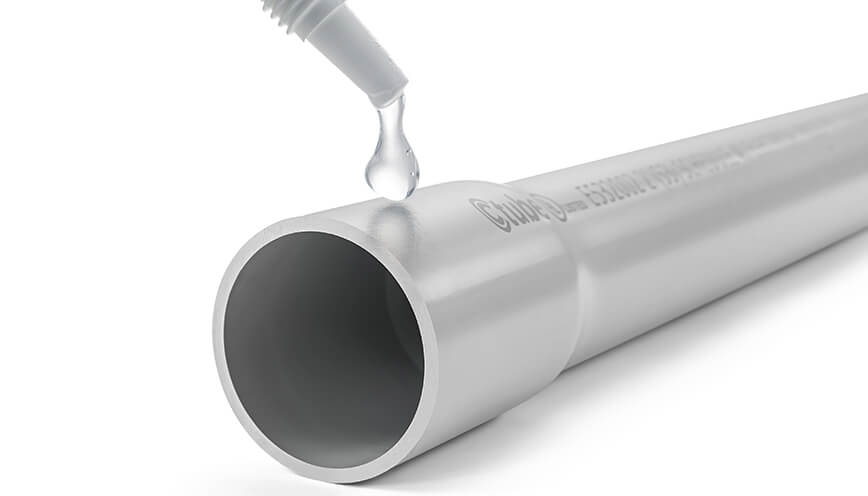
Fitting Types and Their Impact
- Solvent-Welded PVC Fittings: For rigid PVC conduit, solvent-welded couplings provide a continuous, monolithic pathway. Unlike threaded or push-fit connectors, properly glued joints prevent water ingress and minimize stress concentrations. This is particularly important in high-moisture or rain-exposed locations.
- Set-Screw vs. Compression Connectors (Metal Conduits): RMC, IMC, and EMT commonly use set-screw or compression-type fittings. Set-screw connectors can allow tiny gaps if overtightened or misaligned, which may let moisture wick into the conduit. Compression fittings create a tighter seal but require correct torque and periodic inspection.
- Liquid-Tight Flexible Conduit Fittings (LFNC/LFMC):Flexible conduits require UL-listed liquid-tight connectors to maintain wet-location ratings. These fittings must compress the jacket and inner core simultaneously to prevent water penetration. Improperly matched connectors can void the system’s wet-location rating, regardless of the conduit material.
Gasketed Enclosures and Conduit Bodies
- Gasketed Boxes: NEMA 3R, 4, or 4X boxes with neoprene or EPDM gaskets are essential for wet and high-humidity applications. Covers must seat properly, and fasteners should be tightened evenly to maintain the seal.
- Hub-Style and Conduit Body Connections: Gasketed hubs or sealed conduit bodies prevent water from tracking along the conduit. Even small misalignments or omitted gaskets can compromise an entire run.
Installation Details That Ensure Water Resistance
- Alignment and Support: Misaligned fittings, overly tight bends, or unsupported runs create stress points that can compromise seals. Maintain minimum bend radii and proper spacing for supports according to NEC guidelines.
- Sealing Practices: Use approved sealants, duct seal, or pourable foams at transitions from underground to above-grade, or where conduits enter enclosures. Avoid overfilling, which can deform gaskets or compress flexible conduits.
- Compatibility: Always confirm that each fitting, connector, and enclosure is listed for the conduit type and wet-location rating. Mixing incompatible components is a common source of failure, even when individual parts meet UL or NEC requirements.
Testing and Verification
- UL and ASTM Compliance: Look for UL-listed fittings and enclosures tested for UV, moisture, and temperature extremes. Products complying with ASTM G154 (UV exposure) or UL 651A/UL 514B standards provide additional confidence.
- Inspection After Installation: Verify seals visually and, if possible, perform water testing to confirm that joints remain watertight. This is particularly important for rooftop, coastal, or high-vibration applications.
6. Conclusion
Selecting the right conduit material is only one part of achieving reliable outdoor electrical installations. Throughout this guide, we’ve seen that true weather resistance depends on a holistic, system-level approach: matching conduit types, fittings, boxes, and installation techniques to the specific environmental challenges of each application. UV exposure, moisture intrusion, mechanical impact, corrosive conditions, and temperature fluctuations all interact to stress outdoor conduits, making careful material selection alone insufficient.
By assessing the environment first, choosing materials suited to the mechanical and chemical demands, and integrating properly rated fittings and enclosures, installers can build systems that stand the test of time. Flexible conduits protect against vibration and alignment shifts, gasketed enclosures prevent water ingress, and solvent-welded or UL-listed connections ensure continuity of protection across every joint. Each element of the system contributes to long-term reliability, demonstrating that the weakest link often lies in the interfaces rather than the conduit itself.
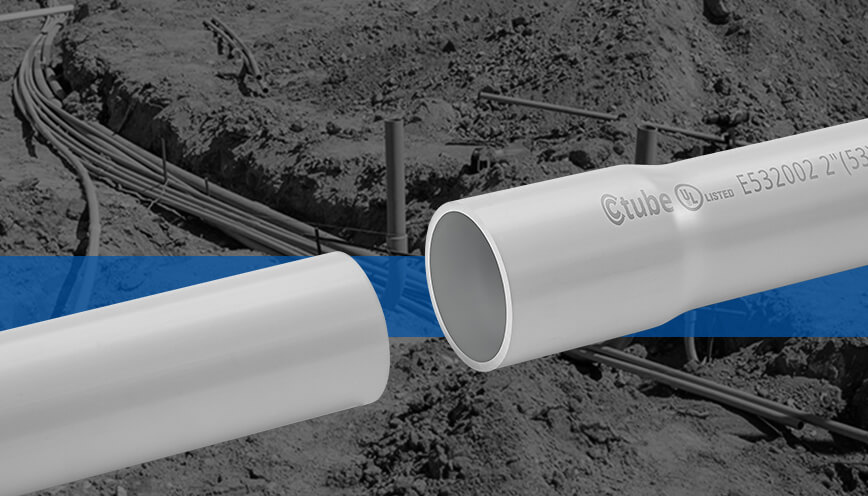
At Ctube, we offer a full range of PVC conduits, fittings, and enclosures engineered for outdoor performance. By providing compatible, high-quality components and supporting proper installation practices, Ctube helps electrical professionals implement fully weatherproof systems that comply with UL, CSA, AS/NZS 2053 standards and endure the harshest conditions—from residential landscapes to industrial and coastal installations.
Thank you for taking the time to read this guide. We hope it is helpful. Wishing you smooth and successful installations! If you have any project requirements or need guidance on selecting the right conduit, don’t hesitate to contact us.

FAQs
Are there special considerations for conduit in high-altitude or desert environments?
Yes. High UV exposure, extreme temperature swings, and low humidity in these regions accelerate material aging. Use UV-stabilized PVC or coated metal conduits, ensure proper gasketed enclosures, and consider expansion fittings to accommodate thermal movement.
How can I prevent water from entering conduit at the underground-to-above-grade transition?
Use long-radius elbows for smooth wire pulls, expansion fittings for thermal movement, and seal all entry points with approved duct seal or pourable foam. Ensure the stub-up rises at least 18 inches above grade per NEC 300.5(J).
Are gasketed fittings and boxes mandatory for all outdoor conduits?
Not for every application, but they are strongly recommended in wet, high-humidity, or splash-prone locations. Even in partially protected areas, using gasketed enclosures significantly reduces the risk of moisture-related failures.
Can corrosion-resistant metal conduits be used near saltwater without special coatings?
Bare galvanized or stainless steel may still corrode in high-salt environments. Use epoxy-coated RMC, IMC, or non-metallic alternatives like UV-stabilized PVC or RTRC to ensure longevity.
Do weatherproof conduit systems require any special grounding considerations?
Yes. Metal conduits (RMC, IMC, EMT) can serve as grounding paths, but non-metallic systems must incorporate separate grounding conductors. Always follow NEC grounding requirements for outdoor installations.



 English
  French
  Spanish
  German
  Arabic
  Indonesian
  Vietnamese