مقارنة شاملة بين أنابيب EMT والأنابيب الصلبة

1. المقدمة

Choosing the right electrical conduit is one of the most important decisions in any wiring installation, whether you’re working on a commercial project, an industrial facility, or a residential upgrade.

Different environments demand different levels of protection, durability, flexibility, and compliance with electrical codes, which is why understanding conduit types is essential for both safety and performance.

Among all available options, EMT (Electrical Metallic Tubing) and Rigid Conduit are two of the most widely used systems in North America. Although they may look similar at first glance, they serve very different purposes.

EMT is lightweight, easy to bend, and cost-effective—ideal for fast installations. Rigid conduit, on the other hand, provides maximum mechanical protection and superior resistance to harsh environments, making it the preferred choice for demanding or outdoor applications.

In this guide, we’ll help you clearly understand the differences between EMT and Rigid conduit by walking you through their structure, characteristics, code requirements, applications, advantages, limitations, and installation considerations.

2. Understanding EMT Conduit Electrical Metallic Tubing

2.1 What Is EMT Conduit?

EMT (أنابيب معدنية كهربائية) is a thin-wall metal conduit commonly used in commercial and light industrial wiring. It is an unthreaded, circular raceway designed to protect and route conductors and cables, and is typically made from steel with protective coatings or, in some cases, aluminum.

مقارنة شاملة بين أنابيب EMT والأنابيب الصلبة - EMT

At a glance, EMT looks quite similar to rigid metal conduit, and in some classifications it’s loosely grouped under the rigid family. But because its walls are much thinner and the tubing is lighter and easier to bend, electricians usually refer to EMT as its own category.

Different EMT materials correspond to different product standards, and in the following sections we will focus primarily on UL 797A – Electrical Metallic Tubing (Aluminum and Stainless Steel) and UL 797 – Electrical Metallic Tubing ( Steel) . When sourcing EMT, make sure to confirm the material type and applicable standard.

2.2 Characteristics of EMT Conduit

EMT (Electrical Metallic Tubing) is designed not only to provide physical protection and routing for electrical conductors but also to maintain mechanical integrity under various conditions. Its key characteristics are largely defined by standardized testing procedures that ensure reliability in real-world installations.

One important aspect of EMT is its bendability and ductility. EMT is tested at both ambient and low temperatures to verify that it can be bent without cracking, weld seam separation, or significant distortion of the circular cross-section. Small-size tubes (such as ½”, ¾”, and 1″) are specifically tested for both ambient and 0°C (32°F) conditions using mandrels and standardized bend fixtures, while larger sizes follow appropriate bending procedures governed by specified minimum bend radii.

These tests, defined under standards such as UL 797 and CSA C22.2 No. 83-104, ensure that EMT maintains its shape and mechanical performance across a range of temperatures and tube sizes.

2.3 Sizes of Electrical metallic tubing

يجب أن يكون القطر الخارجي والوزن الأدنى للأنابيب المعدنية الكهربائية النهائية كما هو موضح في الجدول 5.1. يجب أن يكون الطول القياسي للأنابيب المعدنية الكهربائية 3.05 م (10 أقدام) ±6 مم (±1/4 بوصة).

Table  – Dimensions and Weights of EMT
Metric Designator Outside Diameter (mm) Minimum Acceptable Weight (kg/m) Trade Size Outside Diameter (in) Minimum Acceptable Weight (lbs/ft)
16 17.93 ± 0.13 0.424 1/2 0.706 ± 0.005 0.285
21 23.42 ± 0.13 0.647 3/4 0.922 ± 0.005 0.435
27 29.54 ± 0.13 0.952 1 1.163 ± 0.005 0.640
35 38.35 ± 0.13 1.414 1-1/4 1.510 ± 0.005 0.950
41 44.20 ± 0.13 1.637 1-1/2 1.740 ± 0.005 1.10
53 55.80 ± 0.13 2.083 2 2.197 ± 0.005 1.40
63 73.03 ± 0.25 3.051 2-1/2 2.875 ± 0.010 2.05
78 88.90 ± 0.38 3.720 3 3.500 ± 0.015 2.50
91 101.60 ± 0.50 4.837 3-1/2 4.000 ± 0.020 3.25
103 114.30 ± 0.50 5.506 4 4.500 ± 0.020 3.70

 2.4 What’s the color standards of EMT?

تُستخدم الأنابيب الملونة بشكل متزايد في تصميم المباني والإنشاءات. ويدرك العديد من مديري المرافق فوائد الأنابيب الملونة وقد طوروا إرشاداتهم الخاصة لتطبيقها في المشاريع الجديدة، بما في ذلك المباني الذكية والمرافق الحكومية والمؤسسات التعليمية.

مقارنة شاملة بين أنابيب EMT والأنابيب الصلبة - color-emt

حتى الآن، لا تحدد معايير NEC وغيرها من معايير NFPA/UL أكواد ألوان رسمية للممرات أو الكابلات في مشاريع البناء الجديدة. ولا تزال صناعة الكهرباء تفتقر إلى معيار ألوان رسمي للأنابيب أو EMT (الأنابيب المعدنية الكهربائية). ولا توجد ألوان محددة للدوائر أو مستويات الجهد المختلفة، لذا فإن اختيارات الألوان لـ EMT غالبًا ما تتأثر بالتفضيلات المعمارية وليس الأغراض الوظيفية.

على الرغم من عدم وجود متطلبات رسمية، فقد تطورت ممارسات غير رسمية بمرور الوقت. قد تتبنى بعض الصناعات أو الشركات معايير ترميز الألوان الخاصة بها لتلبية احتياجات تشغيلية أو بروتوكولات أمان محددة.

Here are some commonly used colors for EMT (Electrical Metallic Tubing) and their typical applications.

Color Block طلب
Standard use in contemporary architecture and general applications.
Blends into dark-colored areas, commonly used in architecture.
Often used in construction or research areas, fiber optic systems, and auto repair or maintenance.
Designates high-voltage wiring, caution areas, and special equipment.
Applied in hospital and healthcare settings, nurse call stations, and critical circuits.
Used for low-voltage wiring, data communication, and video systems.
Indicates specialty wiring systems and security systems.
Blends into light-colored areas, suitable for various general applications.
Commonly used for emergency circuits and fire alarm systems.

Note: Color identification and usage practices for EMT conduit may vary by region, industry, or project specification. While the examples above reflect common practices, local codes, standards, and authority having jurisdiction (AHJ) requirements should always take precedence. Always verify conduit color conventions and compliance requirements based on applicable local regulations before installation.

3. Protective Characteristics and Performance of EMT Conduit

EMT is not merely a thin-walled steel conduit; it represents a carefully engineered system designed to resist corrosion, endure mechanical stress, remain stable across diverse environmental conditions, and maintain safety under elevated temperatures or flame exposure. The following sections consolidate these performance aspects into a coherent protection profile, demonstrating how EMT provides a reliable, long-term safeguard for electrical wiring across residential, commercial, and industrial applications.

3.1 EMT Conduit Protective Coatings Overview

To enhance corrosion resistance and prolong service life, EMT is typically finished with protective coatings, which can be metallic, nonmetallic, or organic. Metallic coatings, such as zinc plating, act as a primary barrier against corrosion. The integrity of the zinc layer is evaluated through the copper sulfate test, where a bright, adherent copper deposit indicates inadequate protection. A properly applied zinc coating on the exterior of EMT should prevent a bright copper deposit after four 60-second immersions, while interior zinc coatings are tested with one immersion.

Organic and polymer-based coatings provide alternate corrosion resistance, especially for applications requiring exposure to moisture, chemicals, or higher temperatures. These coatings are evaluated for elasticity, adhesion, flammability, and resistance to ultraviolet light, water, and environmental stressors, including salt spray and humid carbon dioxide-sulfur dioxide-air exposure. Coatings are also subjected to air-oven conditioning and cold-impact testing to ensure durability under extreme temperatures. Adherence and tensile strength tests confirm that the coating remains intact and effective throughout mechanical handling and environmental exposure. Together, these protective measures ensure that EMT maintains both its mechanical integrity and corrosion resistance over its service life, as specified in UL 797A standards.

3.2 Mechanical Performance of EMT Conduit

The mechanical performance of EMT is critical to ensure its durability during installation and service. Standard testing evaluates both ambient and low-temperature bending to verify ductility and structural integrity. At ambient temperature, the smallest EMT size is bent through a 90° arc without a mandrel. Acceptance criteria include no cracking, no weld seam separation, and minimal distortion of the circular cross-section.

For low-temperature conditions (0°C / 32°F), specimens are conditioned for 60 minutes and bent around a mandrel to form a 90° arc. The bending process must be completed within 15 seconds of removal from the cold chamber. Tubes with nonmetallic corrosion-resistant coatings are tested at their rated minimum temperatures. Larger EMT sizes may use suitable bending equipment, but the bend radius remains governed by standard specifications.

In addition to bending, cold impact tests simulate accidental knocks or drops during handling and installation. Specimens are conditioned at the rated low temperature, then subjected to controlled impact energy. The coating must not separate from the metal, nor should bare metal be exposed. These rigorous mechanical tests, as outlined in UL 797A and CSA C22.2 No. 83-104, confirm that EMT can withstand bending, cold, and impact stresses without compromising its protective coating or structural integrity, ensuring long-term reliability in field installations.

3.3 Environmental Resistance of Electrical nonmetallic Tubing

EMT conduit must withstand various environmental stresses to ensure long-term performance. Protective coatings—zinc, organic, or other alternate corrosion-resistant materials—are tested for resistance to moisture, corrosive atmospheres, ultraviolet (UV) light, and temperature extremes.

Salt spray (fog) tests expose both as-received and air-oven conditioned specimens to a saline mist for 600 hours. Unscribed specimens must show minimal corrosion, while scribed specimens are evaluated based on the creeping distance of red rust, ensuring that coating adhesion and substrate protection are maintained.

For moist carbon dioxide-sulfur dioxide-air exposure, EMT samples are subjected to 1200 hours in a controlled chamber. The unscribed surfaces should exhibit only light corrosion, and the scribed areas are limited to a maximum rust creeping distance of 1.6–3.2 mm, with no separation of coating from the substrate. These tests simulate industrial environments with acidic or polluted atmospheres, confirming the coating’s ability to prevent metal degradation.

UV and water exposure tests further assess durability under sunlight and precipitation. Both scribed and unscribed specimens are exposed to controlled cycles of light and water spray using carbon-arc or xenon-arc apparatus. Acceptable results include no blistering or pitting, and minimal rust formation at scribed areas.

Air-oven conditioning simulates prolonged high-temperature exposure, typically at 100°C for 240 hours, before specimens undergo salt spray and moist CO₂-SO₂-air tests. This ensures that thermal aging does not compromise corrosion resistance.

These environmental tests, as defined in UL 797A, validate that EMT conduits with appropriate coatings can maintain protective performance across diverse field conditions, providing reliable corrosion protection for both indoor and outdoor installations.

3.4 Temperature Ratings and Flammability of EMT

EMT conduits are rated for both maximum and minimum ambient temperatures to ensure safe operation under varying field conditions. Tubing with nonmetallic alternate corrosion-resistant coatings is typically marked with a maximum use temperature of 90°C (200°F). When tested for higher ambient temperatures, the conduit is marked with the evaluated temperature rating based on UL 797A Clause 6.2.4.4.1. Similarly, the minimum use temperature is marked at 0°C (32°F) or the lower rated temperature for specially tested conduits (Clause 6.2.1.3). Markings are applied at intervals not exceeding 3.05 m (10 ft) along each length to ensure clear identification.

Flammability performance is critical for EMT conduits in building applications. Vertical specimens of tubing with nonmetallic alternate corrosion-resistant coatings undergo three 60-second flame applications, with 30-second intervals. The conduit must not continue to flame for more than 5 seconds after any application, nor emit flaming particles that ignite surrounding cotton. Coating consumption is not permitted during or after flame exposure. The test setup follows precise guidelines for specimen positioning, burner dimensions, flame height, and temperature (tip of blue inner cone ≥ 816°C / 1500°F), ensuring reproducible and consistent evaluation (Clauses 6.2.4.11.1–6.2.4.11.8).

Compliance with these temperature and flammability standards guarantees that EMT conduits maintain mechanical integrity and protective coatings under both thermal stress and potential fire exposure, meeting stringent safety requirements for commercial and light industrial installations.

3.5 Markings

Each finished EMT straight length and factory elbow shall be marked with the manufacturer’s name, trade name, or other distinctive marking. If the responsible organization differs from the manufacturer, both shall be identified. Private labels may also be identified.

In the U.S., tubing and elbows from multiple factories must have distinctive factory markings (may be coded). This does not apply in Canada.

Each straight length and elbow shall be legibly marked “Electrical Metallic Tubing” or “EMT”, with letters at least 3 mm (1/8 in) high, using durable methods (die stamping, ink, paint).

Each finished piece shall be marked “Consult manufacturer for proper installation” or equivalent wording.

Tubing with a nonmetallic alternate corrosion-resistant coating may be marked with a maximum use temperature of 90°C (200°F) or the tested maximum. Marking frequency: at least once every 3.05 m (10 ft) and at least once per piece.

Similarly, the minimum use temperature may be marked as 0°C (32°F) or the tested minimum, with the same marking frequency.

3.6 Applications of EMT: Where and When to Use

المباني التجارية: EMT is widely used in stores, offices, educational facilities, and restaurants where the wiring environment is clean, dry, and predictable. Its neat appearance and slim profile make it easy to integrate into suspended ceilings and partition walls.

Light Industrial Environments: In light manufacturing, assembly areas, laboratories, and workshops where electrical systems are exposed to some activity but not heavy mechanical stress, EMT offers a good balance between protection, cost, and flexibility.

مقارنة شاملة بين أنابيب EMT والأنابيب الصلبة - تطبيق الأنابيب الكهربائية

Indoor Residential Garages & Utility Areas: For residential garages, basements, or utility rooms that require visible surface wiring, EMT provides an organized, code-compliant, and visually clean solution without the need for heavy-duty conduit systems.

Public and Institutional Buildings: Hospitals, schools, airports, and community centers often use EMT for exposed or semi-concealed runs because it allows fast installation, clean routing, and easy future maintenance.

Ceilings and Partition Walls in New Construction: Because EMT bends smoothly and routes neatly through tight architectural spaces, it is highly suitable for wiring in ceilings and light partition walls in new construction, enabling quick installation while maintaining structural integrity.

Low- to Moderate-Risk Utility Spaces: In mechanical rooms, equipment closets, and indoor service corridors where temperature, humidity, and physical risks are controlled, EMT provides sufficient protection while allowing convenient maintenance.

4. Understanding Rigid Conduit: Types, Features, and Uses

4.1 What’s rigid conduit?

يشير مصطلح "المواسير الصلبة" إلى نوع من المواسير الكهربائية التي تتميز ببنيتها الصلبة ذات الجدران السميكة. تم تصميم هذه المواسير لتوفير مسار وقائي قوي ودائم للأسلاك الكهربائية. وعلى عكس المواسير المرنة، فإن المواسير الصلبة صلبة وغير مرنة، مما يوفر حماية فائقة ضد التلف المادي والعوامل البيئية.

يمكن أن تكون الأنابيب الصلبة غير معدنية أو معدنية، وتندرج أنواع مختلفة ضمن هذه الفئات. تصنع الأنابيب المعدنية عمومًا من الفولاذ المطلي أو الفولاذ المقاوم للصدأ أو الألومنيوم، مع أو بدون مسار قابل للربط. تتوفر الأنابيب غير المعدنية غير الملولبة ذات الجدران الملساء في ركائز متعددة بما في ذلك البولي إيثيلين عالي الكثافة، والبولي فينيل كلوريد، والألياف الزجاجية.

It is important to note that, depending on custom and context, the term “rigid conduit” is sometimes used interchangeably with “rigid metal conduit” to refer to the metal type specifically. However, in a broader sense, it can also include other rigid types like polyvinyl chloride (PVC) conduit.

4.2 What’s the types of Rigid conduit?

مقارنة شاملة بين أنابيب EMT والأنابيب الصلبة - rmc - أنابيب معدنية صلبة

Rigid Metal Conduit (RMC) is a threadable raceway of circular cross section designed for the physical protection and routing of conductors and cables. (Refer in NEC article 344)

يتم تنظيم بناء الأنابيب المعدنية الصلبة (RMC) بموجب معايير مختلفة، مثل NEC 344.100، التي تحدد المواد التي يمكن استخدامها لتصنيع الأنابيب المعدنية الصلبة. وفقًا لهذا المعيار، يجب أن تكون الأنابيب المعدنية الصلبة مصنوعة من إحدى المواد التالية: الفولاذ مع الطلاء الواقي، والألمنيوم، والنحاس الأحمر، والفولاذ المقاوم للصدأ.

مقارنة شاملة بين أنابيب EMT والأنابيب الصلبة RAC

It’s worth noting that Galvanized Rigid Steel Conduit (GRC) is a specific type of Rigid Metal Conduit (RMC) made from galvanized steel. The galvanization process involves coating the steel with a layer of zinc to enhance its corrosion resistance, making GRC particularly suitable for outdoor and industrial applications where exposure to moisture, chemicals, or other corrosive elements is a concern.

نظرًا لأن GRC يشار إليه عادةً باسم RMC، فقد يكون هناك بعض الارتباك عند الشراء. لذلك، من الضروري التأكد من المورد الخاص بك بشأن المواد المستخدمة بالضبط في بناء الأنابيب لضمان أنها تلبي المتطلبات المحددة لمشروعك. هذا التمييز مهم لأنه في حين يوفر GRC متانة ممتازة ومقاومة للتآكل، فإن مواد أخرى مثل الألومنيوم أو النحاس الأحمر أو الفولاذ المقاوم للصدأ قد تكون أكثر ملاءمة اعتمادًا على التطبيق والظروف البيئية.

In addition to Galvanized Rigid Conduit (GRC), there are other types of rigid conduits, including Rigid Aluminum Conduit (RAC) and Rigid Steel Conduit (RSC), each serving specific purposes based on their material properties. The names of these conduits directly indicate the material they are made from.

مقارنة شاملة بين أنابيب EMT والأنابيب الصلبة RSC

Rigid Aluminum Conduit (RAC) is made from lightweight yet durable aluminum, offering excellent resistance to corrosion and making it ideal for both indoor and outdoor applications where ease of handling and reduced weight are beneficial.

Rigid Steel Conduit (RSC), on the other hand, is constructed from robust steel, providing superior strength and mechanical protection for electrical wiring in harsh or high-impact environments.

يوفر كل من RAC وRSC مزايا مميزة اعتمادًا على ظروف التثبيت ومتطلباته، مما يمنح المستخدمين المرونة في اختيار مادة الأنابيب المناسبة لاحتياجاتهم المحددة.

Always verify the material specifications with your supplier to ensure you are getting the right type of conduit for your needs, particularly when the term “RMC” is used interchangeably with “GRC.”

الأنابيب المعدنية الوسيطة (IMC)

مقارنة شاملة بين أنابيب EMT والأنابيب الصلبة - imc

Intermediate Metal Conduit (IMC) is a steel threadable raceway of circular cross section designed for the physical protection and routing of conductors and cables. (Refer in NEC article 342)

يجب أن تكون الأنابيب المعدنية المتوسطة مصنوعة من أحد المواد التالية: الفولاذ المغطى بطبقات واقية، والفولاذ المقاوم للصدأ. يزن الأنبوب المعدني المتوسط (IMC) حوالي 33% أقل من الأنبوب المعدني الصلب (RMC).

مقارنة شاملة بين أنابيب EMT والأنابيب الصلبة - أنابيب الألياف الزجاجية RTRC

Reinforced Thermosetting Resin Conduit (RTRC) is a rigid nonmetallic raceway of circular cross section, with integral or associated couplings, connectors, and fittings for the installation of electrical conductors and cables. (Refer in NEC article 353)

تُصنع أنابيب RTRC المعروفة أيضًا باسم أنابيب الألياف الزجاجية، عن طريق لف خيوط الألياف الزجاجية بالشد فوق عمود دوار، قبل تشريب الخيوط بالراتنج والتصلب تحت درجة حرارة عالية، مما ينتج عنه قوة انثناء عالية ومقاومة لدرجات الحرارة العالية. تتميز أنابيب RTRC بمقاومتها للتآكل، وثباتها للأشعة فوق البنفسجية، ونطاق درجة الحرارة المتفوق (بما في ذلك التعامل الممتاز في درجات الحرارة المنخفضة).

مقارنة شاملة بين أنابيب EMT والأنابيب الصلبة - أنابيب PVC من الجدول 40

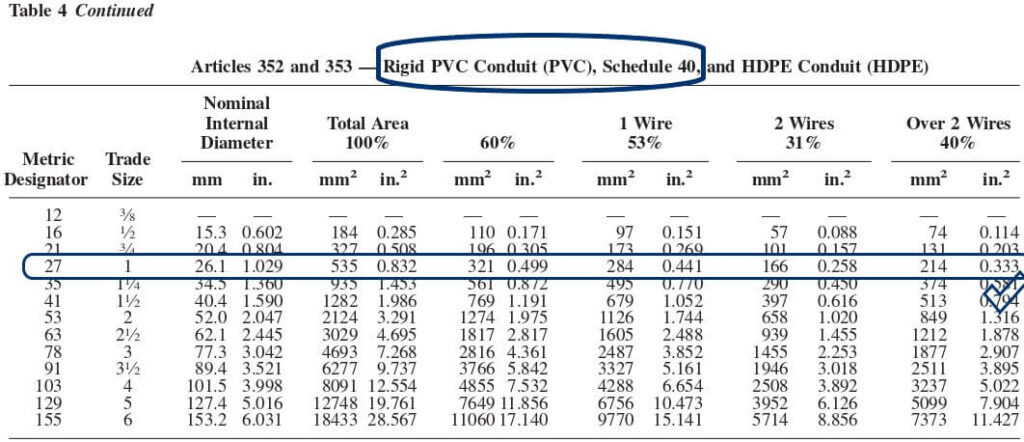
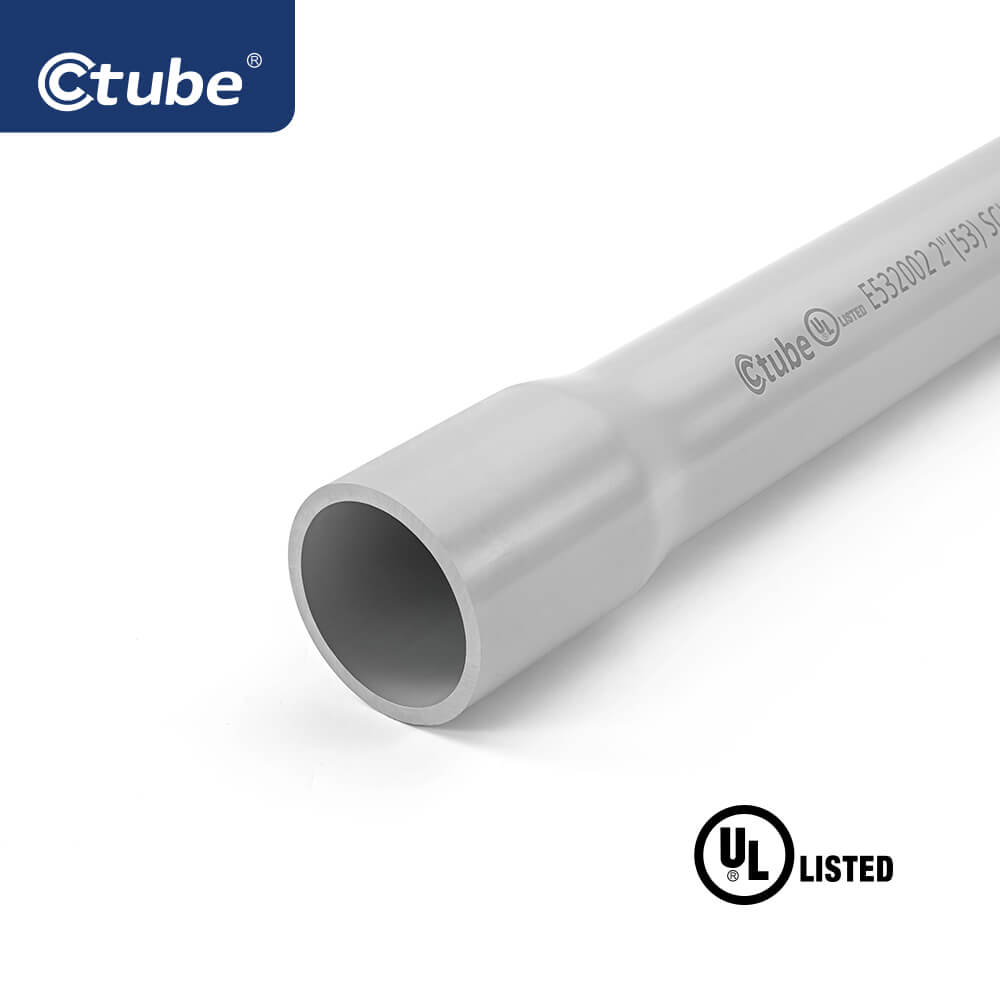
Rigid Polyvinyl Chloride Conduit (PVC) is a rigid nonmetallic raceway of circular cross section. (Refer in NEC article 352)

يتم تصنيع أنابيب PVC الصلبة من كلوريد البولي فينيل، وهو بلاستيك شديد التحمل معروف بمقاومته الاستثنائية للرطوبة والمواد الكيميائية والعوامل البيئية. غالبًا ما تتضمن التركيبة المحددة لـ PVC المستخدمة في الأنابيب إضافات لتعزيز الخصائص مثل مقاومة الأشعة فوق البنفسجية والمرونة ومقاومة الصدمات. تضمن هذه الإضافات أداء الأنابيب بشكل جيد في ظروف مختلفة، بما في ذلك الطقس القاسي والتعرض لأشعة الشمس.

4.3 What’s the Sizes of Rigid Conduit?

تعتبر شركة RTRC أكثر تحديدًا بعض الشيء، وبناءً على المعلومات الواردة من بعض البائعين، فإننا نعلم أن الألياف الزجاجية لديها مجموعة من الأنواع المختلفة من الأنابيب الكهربائية لتلبية متطلبات أنواع مختلفة من الوظائف.

شركة آر إم سي اي ام سي PVC Conduit (SCH 40) مركز أبحاث ودراسات حقوق الإنسان
1/2 0.104 1/2 0.078 1/2 0.109 3/4 سماكة
3/4 0.107 3/4 0.083 3/4 0.113 1 SW = Standard Wall
1 0.126 1 0.093 1 0.133 1-1/4 MW = Medium Wall
1-1/4 0.133 1-1/4 0.095 1-1/4 0.14 1-1/2 HW = جدار ثقيل
1-1/2 0.138 1-1/2 0.1 1-1/2 0.145 2 XW = جدار ثقيل جدًا
2 0.146 2 0.105 2 0.154 2-1/2
2-1/2 0.193 2-1/2 0.15 2-1/2 0.203 3
3 0.205 3 0.15 3 0.216 3-1/2
3-1/2 0.215 3-1/2 0.15 3-1/2 0.226 4
4 0.225 4 0.15 4 0.237 4-1/2
5 0.245 5 0.28 5
6 0.268 6 غير متاح 6
8 0.322
*Inch is used as the unit for measuring wall thickness here.*

على سبيل المثال، تحتوي سلسلة IPS على جدار قياسي (SW)، سمك .070، وجدار متوسط (MW)، سمك .096، وجدار ثقيل (HW)، سمك 110، وجدار ثقيل للغاية (XW)، سمك 250.

من المهم ملاحظة أن الأبعاد المذكورة هنا، إلى جانب سمك الجدار المقابل، قد تختلف قليلاً حسب المورد. تندرج هذه الاختلافات ضمن النطاق المقبول القياسي. للحصول على معلومات محددة حول سمك الجدار، يرجى التأكد مباشرة من المورد.

4.4 What’s the Advantage of Rigid Conduit?

Durability and Strength: Rigid conduit is highly durable and resistant to physical damage. Its solid construction protects electrical wiring from impacts, crushing, and other potential hazards, making it suitable for both exposed and concealed installations in demanding environments.

Protection Against Environmental Factors: Rigid conduit provides excellent protection against environmental elements such as moisture, chemicals, and UV radiation. This makes it ideal for outdoor installations, underground wiring, and environments where exposure to harsh conditions is a concern.

مقاومة الحريق: Certain types of rigid conduit, such as steel conduit, offer fire-resistant properties, helping to contain the spread of flames in the event of a fire. This enhances the overall safety of the electrical system.

Long Lifespan: Due to its robust construction and resistance to corrosion and wear, rigid conduit has a long service life. This reduces the need for frequent replacements or repairs, leading to lower maintenance costs over time.

Versatility in Applications: Rigid conduit is versatile and can be used in a wide range of applications, from residential to industrial environments. It is suitable for both above-ground and underground installations, as well as in special environments like coastal areas or high-temperature settings.

مقارنة شاملة بين أنابيب EMT والأنابيب الصلبة - أنظمة الأنابيب المعدنية الكهربائية - بناء الأنابيب

4.5 What’s the Application of Rigid conduit?

Outdoor Installations & Service Entrances: Rigid conduit is ideal for exposed outdoor runs, service entrances, and exterior wall installations where the raceway may encounter weather, physical contact, or accidental impact. Its strong wall construction and protective coatings offer long-lasting resistance to moisture, UV exposure, and corrosion.

Industrial Facilities & Heavy Manufacturing: Factories, production plants, refineries, and heavy manufacturing environments often rely on rigid conduit because forklifts, machinery, and material-handling activities introduce high mechanical risks. Rigid conduit provides maximum protection for critical wiring systems thanks to its superior impact resistance and structural strength.

Hazardous Locations (Classified Areas): Chemical plants, petrochemical facilities, wastewater treatment sites, and flammable material storage zones frequently require rigid conduit due to its containment capability and compatibility with explosion-proof fittings. It helps reduce ignition risk in classified environments.

التركيبات تحت الأرض: Rigid conduit is commonly used for underground service conductors and buried pathways where soil pressure, moisture, and shifting conditions may damage lighter conduit types. Its rigidity and corrosion-resistant coatings ensure long-term reliability.

High-Traffic Public Areas: Transit stations, stadiums, parking structures, and public infrastructure benefit from rigid conduit’s exceptional impact resistance. Its robust construction helps prevent damage caused by the public, carts, vehicles, or equipment.

Structural Installations Requiring Additional Support: In situations where the conduit system may also serve as mechanical support—such as mounting pull boxes, junction boxes, or other fixtures—rigid conduit’s strength and load-bearing capability help maintain system stability.

Corrosive or Harsh Environments: With options such as hot-dip galvanizing, PVC coatings, or corrosion-resistant alloys, rigid conduit can withstand marine environments, coastal regions, food processing facilities, and chemical exposure zones where corrosion protection is crucial.

5. EMT vs. Rigid Conduit: A Practical Comparison

Choosing between EMT and rigid conduit often comes down to balancing protection level, installation conditions, cost, and code requirements. While EMT provides lightweight versatility and is widely used in commercial and light industrial projects, rigid conduit—available in steel, aluminum, PVC, fiberglass, and more—offers a broader spectrum of durability and environmental resistance. Because rigid conduit covers many materials and standards, performance can vary widely across products.

مقارنة شاملة بين أنابيب EMT والأنابيب الصلبة - ثني الأنابيب

To help readers understand the core differences, the table below summarizes the most commonly compared characteristics of EMT and rigid conduit. This overview highlights general trends rather than strict specifications.

فئة EMT (أنابيب معدنية كهربائية) Rigid Conduit (Metal, PVC, or Fiberglass)
Material & Structure Thin-wall steel; light structure; smooth interior Can be steel, PVC, or fiberglass; thick-wall and more robust
سمك الجدار Thin-wall, non-threaded Thick-wall; metal types are threadable
وزن Lightweight; easy to handle and install Heavier; varies by material (steel > PVC > FRP)
Flexibility / Bendability Easy to bend with a hand bender; tight radii possible Limited flexibility; metal requires hydraulic bender; PVC often requires heat
Mechanical Strength Moderate impact/crush resistance High physical protection; supports heavy-duty environments
مقاومة التآكل Zinc-coated; moderate corrosion performance Depends on material: galvanized steel (good), PVC-coated steel (excellent), PVC/FRP (excellent)
Environmental Suitability Ideal for indoor dry or controlled spaces Suitable for indoor/outdoor, underground, corrosive, or harsh locations
Temperature & Flammability Governed by UL 797 / UL 797A Varies by standard: metal (high), PVC/FRP (material-dependent)
Grounding/Bonding Provides a reliable equipment grounding path Metal provides grounding; PVC/FRP does not (needs separate grounding conductor)
EMI Shielding Good shielding Metal rigid: excellent; PVC/FRP: none
Installation Tools Simple tools: hand bender, cutter, reamer Demanding tools: threader (metal), hydraulic bender (metal), heater (PVC)
Installation Labor Faster and easier; lower labor cost Slower; more steps and heavier handling
Fittings Compatibility EMT-specific compression or set-screw fittings Depends on material: threaded (metal), solvent-cement (PVC), adhesive (FRP)
Typical Indoor Use Commercial buildings, light industrial, institutions Mechanical rooms, industrial plants, exposed public areas
Outdoor/Underground Use Limited without added protection Strong suitability; widely used outdoors and underground
Hazardous Locations Not commonly specified Frequently required for Class I/II/III hazardous locations
Cost – Material أدنى Higher (metal), moderate (PVC), mid-high (FRP)
Cost – Installation Lower overall installed cost Higher due to labor/tools
Service Life Long in controlled environments Very long; excellent in demanding environments
Best For Clean, dry, low-to-moderate risk installations Harsh, corrosive, high-impact, outdoor or industrial applications

This comparison is intended for general reference only. Because rigid conduit includes multiple materials and testing standards—and because performance varies significantly between types—this table should not be used as a sole basis for product selection. 

When planning an installation, always review technical data sheets, certifications, and test values from your supplier to ensure the conduit meets your project’s environmental, mechanical, and regulatory requirements.

6. الخاتمة

Choosing the right conduit—whether EMT, rigid metal conduit, PVC, or LSZH—plays a critical role in ensuring electrical system performance, safety, and long-term reliability. Each conduit type offers unique benefits in terms of strength, corrosion resistance, temperature performance, cost, and ease of installation. 

Because conduit materials, standards, and application requirements vary widely, it’s important for contractors, engineers, and inspectors to consider real project conditions rather than relying on a single characteristic or generalized comparison. Factors such as environmental exposure, physical impact, chemical resistance, bending requirements, and regulatory compliance should always guide the final selection.

Additionally, conduit performance can differ significantly between manufacturers. Temperature tolerance, UV resistance, impact strength, and long-term aging properties are directly influenced by raw material quality, resin formulation, stabilizers, and protective coatings. For example, سي تيوب’s Low Smoke Zero Halogen (LSZH) conduit series, specifically designed for fire safety and low-smoke applications, is engineered to operate reliably from –45°C to +150°C (–49°F to 302°F). 

ملكنا أنابيب بلاستيكية series is designed for robustness, chemical resistance, and typical commercial and industrial use, while the Solar Series PVC conduits are formulated for high-heat outdoor environments, maintaining stable performance from –15°C to +105°C (+5°F to 221°F). These distinctions show how different materials can meet diverse project needs.

Thank you for reading! We hope this article is helpful for you.

If you have a project or need more information about our conduits, feel free to contact us. Wishing you a smooth and successful project! 

الأسئلة الشائعة

1. ما هو الفرق بين قناة EMT وIMC؟

IMC (Intermediate Metal Conduit) is heavier and more durable than EMT (Electrical Metallic Tubing) but lighter than RMC (Rigid Metal Conduit). 

EMT is thin-walled, lightweight, and easy to bend, making it ideal for indoor applications where installation speed and cost efficiency matter. 

IMC, with its thicker walls and stronger steel alloy, offers greater protection against physical damage and corrosion, making it suitable for both indoor and outdoor environments. It provides a balance of durability and ease of handling, making it a versatile option in many electrical installations.

2. هل RMC هو نفسه RGS أو EMT؟

RGS (Rigid Galvanized Steel) is a specific type of RMC. Essentially, RGS = galvanized-steel RMC.

RMC and IMC share many characteristics: both use threaded ends, threaded fittings, and sometimes threadless fittings.

IMC has slightly thinner walls but uses a stronger alloy to maintain overall strength, making it lighter, more cost-effective, and offering slightly more fill capacity in the same trade size.

EMT is different—it cannot be threaded and instead uses set-screw or compression connectors. EMT is commonly used indoors and is not suitable for locations “subject to physical damage,” where RMC or IMC would be required.

3. Can EMT and rigid conduit be bent?

Yes. EMT can be bent easily due to its thin walls and lightweight construction, making it ideal for field bending with standard hand benders. 

Rigid metal conduit, however, is significantly harder to bend because of its thickness and strength. While bending equipment exists, bending rigid conduit on site is generally not recommended for most installers. In many cases, it is more practical to use factory elbows, fittings, or choose flexible conduit when direction changes are needed

4. What standards regulate EMT and rigid conduit?

Several major standards govern the construction, performance, and installation of EMT and rigid conduit:

  • الكود الوطني للكهرباء (NEC)
    • المادة 358: Installation requirements for EMT.
    • Articles 342, 344, 355, 352: Requirements for rigid metal conduit and rigid PVC conduit.
  • Underwriters Laboratories (UL) Standards
    • UL 797: Safety requirements and performance tests for EMT.
    • UL 6: Physical, mechanical, and corrosion-resistance tests for rigid metal conduit.
    • يو ال 651: Requirements for Schedule 40 and Schedule 80 rigid PVC conduit.
  • American National Standards Institute (ANSI)
    • معيار ANSI C80.3: Dimensions and tolerances for EMT.
    • أنسي C80.1: Requirements for rigid steel conduit, including material properties and coatings.
  • Canadian Standards Association (CSA)
    • CSA-C22.2 No. 83.1: EMT and elbows.
    • CSA C22.2 رقم 45.2: Rigid metal conduit.
    • CSA C22.2 رقم 211.2: Rigid PVC conduit and fittings.

These examples are provided for reference only. For specific applications, always consult the original standard documents and verify compliance based on supplier-provided technical information.


رائع! شارك هذه الحالة

صورة Ctube

سي تيوب

مصنع مصدر أنابيب PVC: شحن سريع ودعم التخصيص. متوافق مع شهادات ISO 9001 وISO 14001 وISO 45001

اعرف المزيد عن Ctube
أنبوب سي-1

حول سي تيوب

باعتبارها شركة رائدة ومحترفة في تصنيع الأنابيب والتجهيزات المصنوعة من مادة PVC في الصين، تتخصص شركة Ctube في تطوير وإنتاج أنابيب وتجهيزات PVC المبتكرة لإدارة الكابلات وحمايتها. جميع المنتجات معتمدة من قبل UL وAS/NZS 2053 وCSA وCE وROHS وIEC والمزيد. تلتزم شركة Ctube بتقديم منتجات وخدمات عالية الجودة بكفاءة وسرعة لعملائنا في الأسواق العالمية. هل تبحث عن شركة مصنعة وموردة موثوقة للأنابيب الكهربائية المصنوعة من مادة PVC؟ سنكون شريكك الأفضل. اتصل بنا اليوم لمناقشة متطلباتك.

اقتباس سريع

أو راسلنا على البريد الإلكتروني ctube@c-tube.net

منتجات ذات صلة بقنوات الكهرباء

مع أكثر من 10 سنوات من الخبرة

توفر لك Ctube خدمات التخصيص الشاملة لك

طلب عرض أسعار

أدخل تفاصيل المنتج (مثل الطراز والحجم والكمية وما إلى ذلك) والمتطلبات المحددة الأخرى لتلقي عرض أسعار دقيق.