
1. Introduction
When you are building a home or managing a large-scale construction project, it is easy to focus on the things you can see—the marble countertops, the designer faucets, or the elegant tiling.
However, the most critical component of your property is something you will likely never see again once the project is finished: the piping system.
Plumbing is often described as the “veins and arteries” of a building. In modern construction, PPR (Polypropylene Random Copolymer) pipes and fittings are the gold standard for delivering clean, pressurized water. But here is the hard truth: not all PPR is created equal.
Imagine the nightmare of a burst pipe two years after moving in. The water doesn’t just damage the pipe; it ruins your hardwood floors, soaks into your drywall, destroys expensive electronics, and can even cause structural mold. By the time you find the leak, the repair cost is often 10 to 50 times the price of the original pipe.
Choosing low-quality PPR fittings to save a few dollars today is like planting a “time bomb” behind your walls.
Whether you are a homeowner, a contractor, or a distributor, your goal is reliability. A high-quality PPR system is designed to last over 50 years, handling high temperatures and intense pressure without breaking a sweat.
In this guide, we will walk you through the professional “insider” methods to distinguish high-quality PPR pipes and fittings from cheap imitations. By the end of this article, you’ll have the confidence to choose a system that guarantees peace of mind for decades to come.
2. Traditional Quality Benchmarks & Technical Specifications
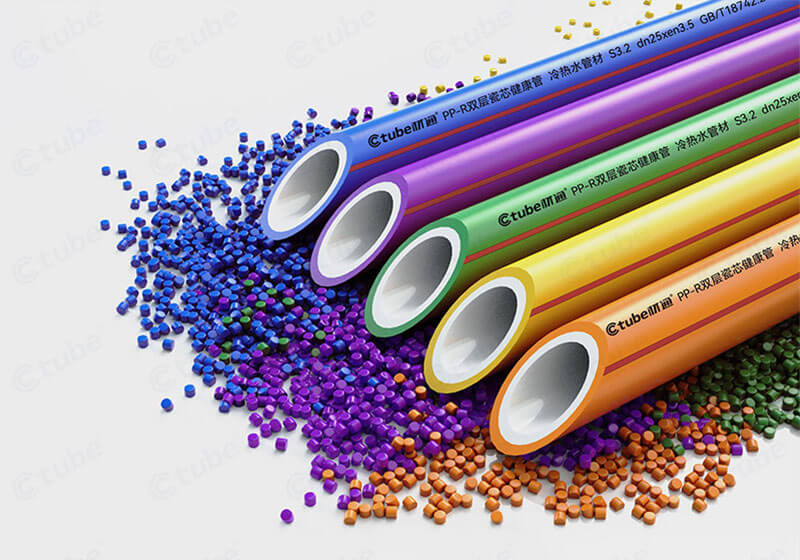
💡 Key Takeaways:
-
Resin Density & MFR: High-quality PPR hinges on an optimized Melt Flow Rate (≤ 0.3g/10min) and correct crystalline density.
-
Insert Metallurgy: Standard brass components are prone to dezincification; commercial engineering requires certified CW617N or DZR brass.
-
Thermal Limits: Low-grade pipes experience premature creep failure within 100 hours at 95°C, while premium pipes withstand 1,000+ hours seamlessly.
To establish a baseline for procurement, we must evaluate both the mechanical properties of the raw random copolymer and the metallurgical integrity of the composite insert fittings. Below are the three verified technical tables that define industry-standard compliance:
2.1 Core Mechanical & Physical Parameters
A premium PPR pipe must balance flexibility with long-term tensile strength. When reviewing factory Material Test Reports (MTC), ensure the following values are satisfied:
Technical Specification Table: What to Look For
When comparing samples, use this data-driven checklist to evaluate the professional markings printed on the pipe.
| Material Type | Corrosion Resistance | Durability | Safety (Lead Content) | Best Use Case |
|---|---|---|---|---|
| HPb59-1 (Common Brass) | Moderate | High | Standard | General residential use. |
| CW617N / CW614N | High | Very High | Low (Food Grade) | Premium drinking water systems. |
| DZR Brass | Excellent | High | Low | High-salinity or acidic water environments. |
| Zinc Alloy (Fake Brass) | Very Low | Brittle | High/Unknown | Avoid. Common in “budget” unbranded fittings. |
2.2 Metallurgy of Threaded Transition Inserts
The connection point between plastic and metal is the most common failure zone in pressurized plumbing. The chemical alloy composition of the insert dictates its pressure and corrosion resistance:
Technical Comparison of Insert Materials
| Evaluation Metric | Premium DZR / CW617N Brass Inserts | Low-Grade Brass / Recycled Scrap (HPb59-1) |
| Lead (Pb) Content | Strictly capped ≤ 2.2% – 3.5% | Often exceeds 4.5%, risking severe heavy metal leaching into potable water. |
| Dezincification Resistance | High resistance; prevents corrosive zinc leaching. | High zinc loss leaves a porous copper shell, causing stress corrosion cracking. |
| Tensile Strength | ≥ 430 MPa; withstands heavy installation torque. | < 300 MPa; threads easily strip or split during high-torque wrenching. |
| Anchoring Grooves | Deep, multi-layered anti-torque geometric knurling. | Shallow or smooth outer walls, causing the metal to spin inside the plastic over time. |
2.3 Thermal Stress Validation
The ultimate metric of structural stability is how the pipe reacts under continuous thermal stress. This is where unverified brands fail catastrophically:
Performance Under Heat: The “Moment of Truth” Test
| Laboratory Test Parameter | Premium PPR Performance | Substandard PPR Performance |
| Test Temperature | 95°C Continuous Hot Water | 95°C Continuous Hot Water |
| Applied Hoop Stress | 3.5 MPa | 3.5 MPa |
| Target Test Duration | 1,000 Hours (Approx. 42 Days) | Fails prematurely between 50 to 150 hours. |
| Structural Integrity | Zero leakage, zero swelling, zero cracking. | Exhibits localized ballooning, weeping, or brittle joint separation. |
3. Advanced Engineering Validation via International Standards
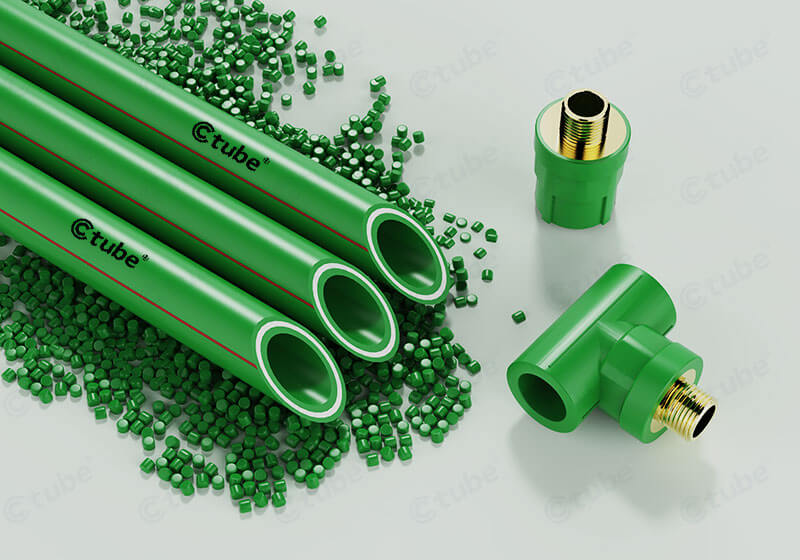
💡 Key Takeaways:
-
ISO 15874-1: Validates molecular classification; only Type 3 (PP-R) or Type 4 (PP-RCT) deliver true thermo-pressure balance.
-
ASTM D2837: Protects infrastructure from the catastrophic “down-turn” stress rupture phenomenon up to 100,000 hours.
-
DVGW W543: Enforces strict systemic dynamic fatigue testing (10,000 pressure cycles) and heavy metal capping.
For high-stakes commercial infrastructure, relying on basic specification tables is not enough. Sophisticated project engineers demand structural traceability backed by international testing protocols.
3.1 Polymer Morphology (ISO 15874-1): The Foundation of System Safety
Many procurement managers see “PPR” on an invoice and assume all materials are equal. However, the exact molecular structure of the plastic determines whether a pipe will safely carry 90°C boiling water or warp and sag within the first year. Substandard manufacturers often blend cheaper plastics (like PP-H or PP-B) into their mix to cut costs. According to ISO 15874-1, insisting on verified Type 3 (PP-R) or Type 4 (PP-RCT) is the only way a buyer can legally ensure the material is structurally matched for commercial hot water systems.
ISO 15874-1 Polypropylene Material Classification
| Polymer Classification | Technical Name | Engineering Application Context |
| PP-H (Type 1) | Polypropylene Homopolymer | High stiffness but extremely brittle at low temperatures; unfit for hot water. |
| PP-B (Type 2) | Polypropylene Block Copolymer | High impact strength but prone to creep deformation under high-temperature loads. |
| PP-R (Type 3) | Polypropylene Random Copolymer | The industrial standard. Optimal balance of thermal resistance and high elasticity. |
| PP-RCT (Type 4) | PP-Random Copolymer (Modified Crystallinity) | Enhanced long-term pressure resistance at elevated temperatures (70°C–95°C). |
3.2 The LTHS “Down-Turn” Prevention (ASTM D2837): Protecting Against 5-Year Liability
The most terrifying scenario for a building contractor is a pipe that passes the initial pressure test on Day 1, but bursts mysteriously in Year 5. This is known in engineering as the “down-turn” phenomenon. Low-grade PPR looks identical to premium PPR, but its molecular chains break down sharply under constant pressure over time. By forcing suppliers to provide ASTM D2837 Long-Term Hydrostatic Strength (LTHS) regression curves, procurement teams eliminate the risk of latent catastrophic failures and multi-million-dollar water damage liabilities.
ASTM D2837 Long-Term Stress Rupture Behavior
| Time Intercept | Premium Resin (Linear Regression) | Substandard Resin (“Down-Turn” Failure) |
| @ 10,000 Hours | Maintains steady, predictable hoop stress resistance. | Passes standard short-term factory static tests. |
| @ 100,000 Hours | Stable: Continuous straight line; satisfies 50-year structural safety margins. | Catastrophic: Experiences a structural “down-turn”, leading to unexpected burst leaks. |
3.3 Dynamic Fatigue & Metallurgy Control (DVGW W543): Surviving Water Hammer and Toxicity
Commercial buildings are harsh environments. Heavy pumps turning on and off create violent hydraulic shocks (water hammer), and rapid hot/cold water shifts cause massive pipe expansion. Furthermore, the brass threaded inserts used to connect valves are often ignored during purchasing. Cheap brass contains high levels of Lead (Pb), which not only poisons the drinking water but also causes the fitting to crumble from dezincification. The strict German DVGW W543 standard is a buyer’s ultimate shield, ensuring the system can survive 10,000 violent pressure shocks and keeping heavy metals out of the potable water supply.
Dynamic System Fatigue & Metallurgy Standards
| Testing Protocol | Regulatory Body | Mandatory Parameter Thresholds | Expected Result |
| System Pressure Cycling | ISO 15874-5 | 10,000 continuous pulses at (30±5) cycles/min under alternating multi-bar loads (up to 15 bar) at 23°C. | Zero leakage, zero joint displacement. |
| Thermomechanical Shock | DVGW W543 | 5,000 continuous alternating cycles between cold water (≤ 25°C) and hot water (85°C). | Zero structural cracking or interface separation. |
| Lead (Pb) Impurity Cap | DVGW W543 | Max ≤ 3.5% (High-performance groups capped at ≤ 2.2%). | Eliminates toxic chemical leaching into potable loops. |
| Arsenic (As) Impurity Cap | DVGW W543 | Max ≤ 0.15% (Capped at ≤ 0.1% to prevent metal embrittlement). | Guarantees zero structural cracking inside the fitting. |
4. Certifications & Standards: The “Global Passport” for Quality
In the international market, quality isn’t just a claim; it is a certification. For SEO and professional procurement, identifying the right “Standards” is the ultimate way to distinguish a tier-one manufacturer from a backyard workshop.

When inspecting the inkjet printing on a PPR pipe, you should look for compliance with these specific international benchmarks:
- ISO 15874: This is the primary international standard for plastic piping systems for hot and cold water. It dictates everything from wall thickness to long-term hydrostatic strength.
- DIN 8077/8078: These are the rigorous German standards. DIN 8077 relates to pipe dimensions and pressure ratings, while DIN 8078 focuses on general quality requirements and testing. A “German Standard” label is a high-trust signal in the PPR industry.
- NSF/ANSI 61: This is critical for Health & Safety. It certifies that the PPR material does not leach lead, BPA, or other chemicals into the drinking water.
Top-tier manufacturers will proudly disclose their raw material source. If you are a high-volume buyer, you should ask for the Technical Data Sheet (TDS) of the resin used.
Pro Tip: Look for names like Borealis (RA130E), Hyosung (R200P), or LyondellBasell. These are the “Intel” of the PPR world. If a manufacturer uses these resins, the quality is almost guaranteed.
5. How Ctube Executes Engineering Precision in Real-World Manufacturing
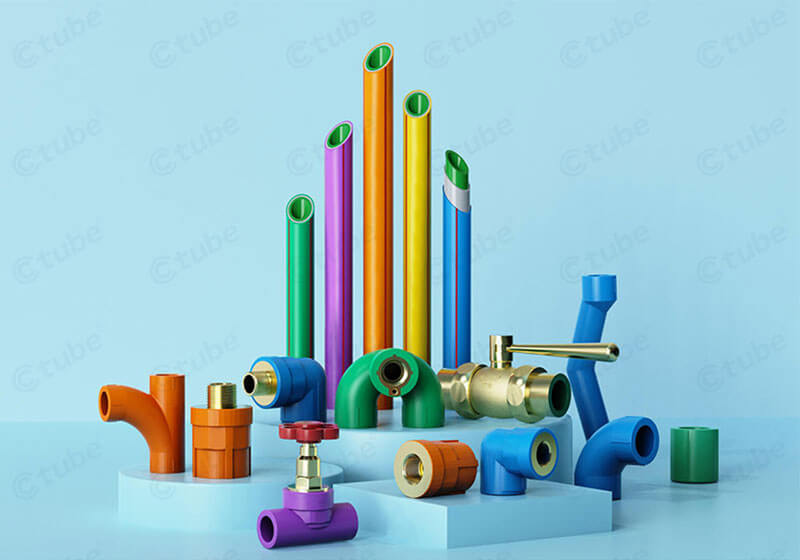
💡 Key Takeaways:
-
Uncompromising Material Purity: 100% pure Hyosung PP-R resin ensures flawless molecular stability.
-
Rigorous QA Testing: In-house laboratories simulate extreme 1,000-hour thermal hydrostatic stress to guarantee batch consistency.
-
Global Trust & Certifications: Backed by international compliance and deployed in landmark infrastructure worldwide.
-
Advanced Smart Infrastructure: State-of-the-art automated extrusion lines eliminate human error.
Knowing the engineering standards is only half the battle; partnering with a manufacturer capable of executing them is the key to project success. At Ctube, quality is not a marketing buzzword—it is a traceable, verifiable manufacturing process.
-
Uncompromising Raw Material Purity: The foundation of a 50-year pipe is what goes into the hopper. We refuse to use blended, recycled, or unverified polymers. Our entire PPR line is extruded exclusively from industry-leading Korean Hyosung PP-R resin. This guarantees that every meter of our pipe matches the flawless linear regression curves defined by ASTM D2837.
-
Rigorous In-House Quality Control & R&D: We don’t wait for third-party audits to find flaws. Ctube operates a comprehensive in-house testing laboratory where production batches are subjected to extreme 95°C / 1,000-hour hydrostatic stress tests and destructive impact validations. Our R&D team continuously pushes the boundaries of polymer performance to ensure our pipes exceed standard safety margins.
-
Global Certifications & Proven Heritage: Our commitment to strict material and metallurgical control has earned Ctube mainstream international compliance certificates (including CE and NSF-equivalent hygienic benchmarks). From luxury residential complexes to high-pressure commercial HVAC loops, our piping systems have been tested and trusted by contractors in major infrastructure projects worldwide.
-
Advanced Smart Manufacturing Equipment: To execute our strict QA protocols at scale, Ctube relies on state-of-the-art infrastructure. We have recently deployed 3 fully-automated intelligent PPR extrusion lines spanning over 15 meters each. Featuring real-time micron-level ultrasonic wall-thickness monitoring and precision thermal control, this smart equipment eliminates human error, ensuring perfect concentricity across every single batch.
👉 Contact Our B2B Project Team for Certified Material Data Sheets
6. Conclusion
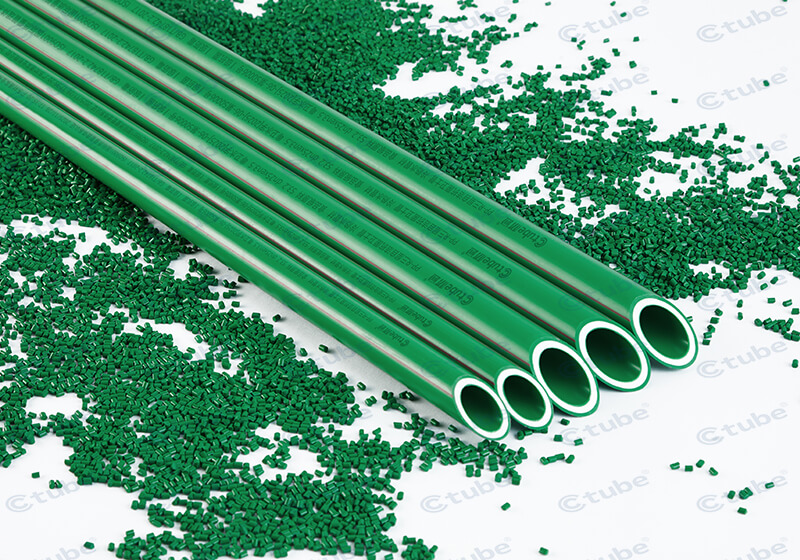
In summary, distinguishing high-quality PPR requires a keen eye for material purity, precise engineering, and adherence to international standards like ISO and DIN.
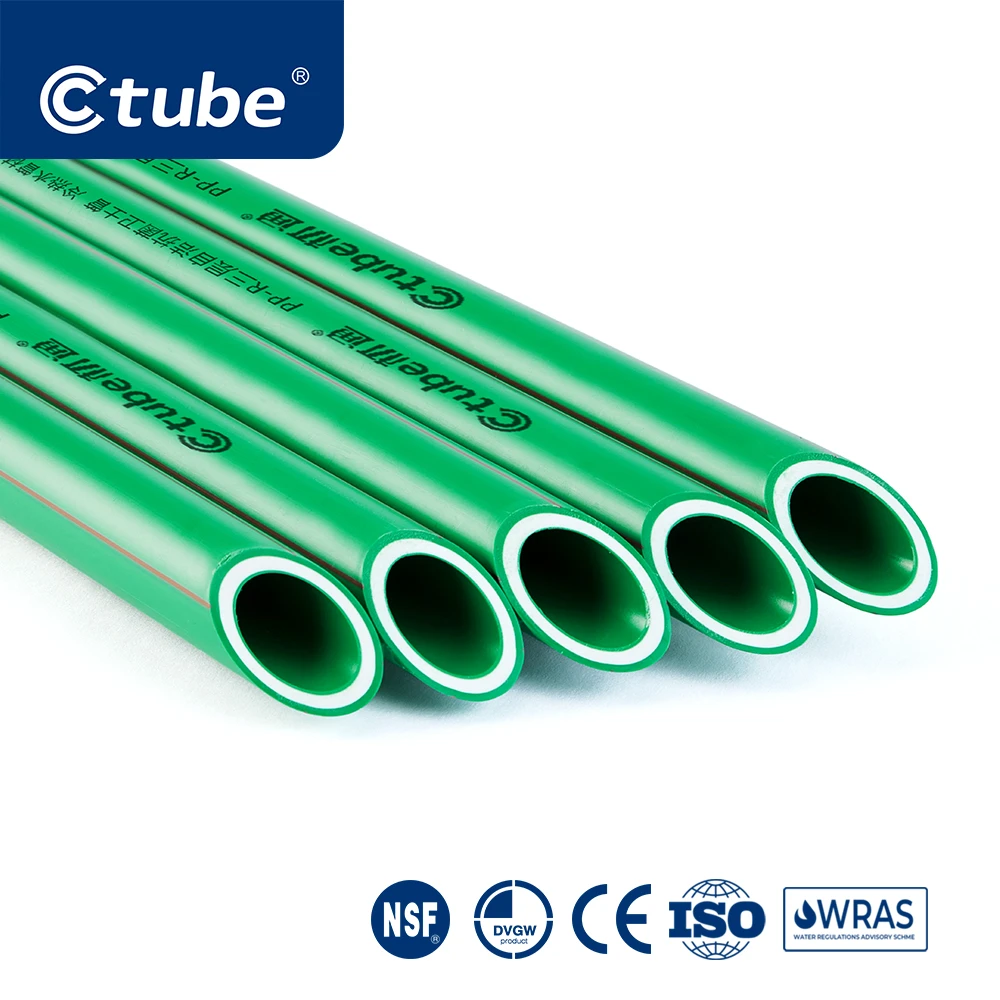
At Ctube, we elevate these industry benchmarks through our specialized R&D. We offer a comprehensive range of single-layer, double-layer, and triple-layer PPR pipes, all of which can be integrated with our advanced anti-bacterial technology.
This ensures that regardless of the structure you choose, your system provides the highest level of water hygiene and long-term protection against microbial growth.
Thank you for reading! Whether you need standard reliability or specialized multi-layer technology, Ctube is committed to delivering the peace of mind your project deserves.
Contact us today to learn more about our latest PPR innovations.

7. FAQs
How can I tell if a PPR pipe is made from recycled materials?
The easiest way to identify recycled PPR is through the "Smell and Smoke" test. When high-quality, virgin PPR is heated for welding, it should be virtually odorless and produce no smoke.
If you detect a pungent, acrid plastic smell or see black smoke, the pipe likely contains recycled scrap or low-grade additives.
Additionally, check for "black spots" or streaks in the pipe’s cross-section, which are signs of contamination.
Can I mix different brands of PPR pipes and fittings?
While it is technically possible if both follow the same international standards (like ISO 15874), it is not recommended. Different manufacturers may use slightly different resin formulas or melting points.
Using the same brand for both pipes and fittings ensures perfect chemical compatibility during the fusion process, which is essential for a leak-free "molecular bond." Most manufacturer warranties are also voided if you mix brands.
What is the difference between PN20 and PN25 PPR pipes?
"PN" stands for Nominal Pressure (measured in bars).
PN20: Designed for a working pressure of up to 20 bar. It is typically used for standard hot water systems.
PN25: Has thicker walls and can handle up to 25 bar. It is usually reserved for high-pressure industrial applications or very high-temperature heating systems. Always ensure your pipe's PN rating matches your project's specific pressure and temperature requirements to avoid bursting.
Does the color of the PPR pipe (Green, White, Grey, Blue) indicate its quality?
No. The color is simply a masterbatch (dye) added during production and does not reflect the quality of the raw material.
Different regions have different preferences: Green is popular in many markets, while White or Grey is common in others.
Why do some PPR pipes become brittle and crack in the winter?
This is usually due to a high concentration of calcium carbonate (chalk) filler. Some manufacturers add this to increase the weight of the pipe while using less expensive resin.
While this makes the pipe feel "solid," it destroys the material's impact resistance, making it crack like glass in cold temperatures.
High-quality PPR maintains "low-temperature toughness" and should be able to withstand minor impacts even in cold weather..
Can your PPR pipes withstand continuous circulation of chlorinated commercial hot water without premature degradation?
Yes. Traditional PPR copper inserts or standard grades can suffer from copper-catalyzed accelerated oxidative degradation when exposed to highly chlorinated municipal hot water loops. Ctube’s premium PPR lines are engineered using advanced Type 3 Random Copolymer stabilized with targeted anti-oxidant packages. Additionally, our brass components undergo structural dezincification resistance processing, ensuring the continuous presence of chlorine dioxide disinfectants does not compromise the pipe wall or fitting interfaces over the system’s 50-year service life.
What is the minimum bend radius for your non-reinforced PPR pipes during cold installations?
Following DVGW W543 Section 7.4.7.1 and global installation metrics, the minimum permissible bending radius for non-reinforced plastic-only pipes must align with a structural safety coefficient derived from the pipe outside diameter (OD). For Ctube PPR pipes, a minimum radius of 8 x OD is mandatory at installation temperatures above 5°C. For instances requiring tight structural offsets in colder conditions, we strictly recommend using pre-molded fusion elbows rather than forcing cold stress bends, mitigating localized residual micro-straining.
How does Ctube guarantee that your raw resin materials are free from "down-turn" stress failure under continuous long-term pressure?
We eliminate long-term field burst risks through rigid implementation of ASTM D2837 and ISO 15874-2 protocols. Every primary material batch we source (100% pure Hyosung PP-R) carries verified long-term hydrostatic strength (LTHS) metrics. Our internal QA laboratory conducts continuous elevated-temperature stress-rupture validation tests up to and exceeding 10,000 hours. This rigorous testing filters out sub-standard molecular chains and ensures our regression lines project an unwavering, straight-line 100,000-hour strength curve without premature stress-rupture down-turns.
Why is the composition of the brass insert in a PPR fitting a critical safety metric for B2B procurement?
Inferior brass inserts with uncontrolled metallurgy cause system leaks via two avenues: coefficient misalignment leaks and chemical leaching. Cheap brass features excess lead contents which lead to dezincification in hard-water environments, causing brittle metal fractures. Ctube strictly adheres to German DVGW W543 Section 4.5.2.3, ensuring all transition fittings utilize EN-certified alloys (like CW617N). We enforce tight caps on impurities: Lead (Pb) is capped at ≤ 3.5%, and Arsenic (As) at ≤ 0.15%. This guarantees mechanical strength, perfect thermal matching with fused plastic, and toxicological safety for drinking water systems.
How do your PPR systems handle aggressive thermomechanical fatigue across commercial hot/cold cycles?
Static hydraulic testing cannot replicate structural contraction shocks. Our quality control system subjects production-run pipe assemblies to rigid dynamic pressure cycling in compliance with ISO 15874-5 Table 12. Test pieces must undergo 10,000 continuous pressure pulses at a rapid frequency of 30 ± 5 cycles per minute. Operating under alternate upper and lower limits proportional to the design rating (up to 15.0 bar for 8 bar systems), our fittings are certified to maintain zero leakage and zero joint displacement.
Do your PPR pipes exhibit a chemical or burnt odor during the socket fusion welding process?
Absolutely not. If an odor or dark smoke occurs during socket fusion at the standard 260℃ welding window, it indicates the presence of volatile recycled plastics, low-grade chemical fillers, or unstable paraffin tracking agents. Ctube’s raw random copolymer resin contains zero cross-contamination. When heated on the welding mandrels, it undergoes clean thermal melting without carbonization or gas generation, protecting both the physical integrity of the cross-linked weld matrix and the health of the on-site installers.
What third-party laboratory certifications does Ctube provide to verify compliance with global hygienic and mechanical standards?
We support large-scale international project biddings with full structural traceability. Ctube PPR piping systems are certified across mainstream global compliance bodies, ensuring conformity to CE (European Conformity), ISO 9001 quality management, and specialized international drinking water toxicological benchmarks (equivalent to NSF/ANSI standards for pristine potable transport). Mill test certificates (MTC) and independent third-party laboratory verification files are readily available upon request for commercial engineering submittals.



 English
  French
  Spanish
  German
  Arabic
  Indonesian
  Vietnamese